Quick Facts: PHP Statistics in November 2026
- 36,829,757 websites use PHP as of November 16, 2026. This is the live count on the PHP technology page, rebuilt every day.
- PHP runs on 11.30% of the 325.8 million websites webatla tracks, about one site in every nine.
- PHP is the most used programming language on the web. It accounts for 91.7% of all detections of the 24 programming languages webatla tracks.
- Among 96 programming languages and web frameworks combined, PHP holds a 69.4% market share.
- PHP has 4.9 times as many sites as Microsoft ASP.NET, 9.5 times as many as Node.js and about 40 times as many as Python or Java.
- PHP is shrinking slowly: -7.6% from October 2023 to October 2026 and -1.5% over the last 12 months.
- In the last 12 months 10.2 million sites came to PHP and 10.7 million left.
- 6.58 million brand new sites launched with PHP in that year, about 18,000 a day.
- WordPress equals 63.8% of the PHP base. Laravel, the largest PHP framework, runs on 514,657 sites.
- 8.3.36 is the most common PHP release (16.5% of sites that show a version). The 7.4.33 release is second with 1,867,498 sites.
- At least 3,360,303 sites still run PHP 7.x or 5.x, 23.4% of sites with a known version.
- 38.0% of PHP sites are hosted in the United States, and 43.7% sit on .com domains.
Every number in this article comes from the webatla index as of November 16, 2026. webatla scans 325.8 million websites, records the technology each one runs and publishes the result as daily files. These PHP usage statistics show how many websites use PHP, how its market share compares with Microsoft ASP.NET, Node.js, Python, Java and Ruby, how the count moved since 2015, which PHP versions are still in production, what software runs on top of PHP and where PHP sites are hosted.
How many websites use PHP in 2026?
PHP runs on 36,829,757 websites as of November 16, 2026. That is every website where webatla detected PHP in today's scan, counted one domain per site.
To get that number we look at every domain that answers with a web server, 325.8 million of them, and record the stack each one runs. PHP shows up in what servers disclose and in the software built on it, so it is one of the most visible server-side technologies at this scale. The count covers blogs, company sites, online shops, forums, news publishers and custom web apps.
To put 36.8 million in perspective:
- It is more websites than WordPress, Squarespace and Shopify have combined.
- It is more than every other programming language and web framework webatla detects put together.
- It is one website in every nine online.
What percentage of websites use PHP?
11.30% of all websites run PHP. The base is the full web as webatla sees it: 325.8 million websites, including parked domains, placeholder pages, redirects, sites on hosted builders and apps built with other languages.
You may have seen much higher figures for PHP elsewhere. Those numbers usually come from a different base: only the most visited sites, or only sites where a server-side language could be identified. Sites that show no server-side language at all drop out of such a base, so the share goes up.
webatla can show three views from the same data:
| Base | Detections | PHP share |
|---|---|---|
| All websites webatla tracks | 325,803,430 websites | 11.30% |
| The 24 programming languages webatla detects | 40,149,803 | 91.7% |
| All 96 programming languages and web frameworks | 53,039,840 | 69.4% |
Out of every website online, about 1 in 9 runs PHP. Out of all programming language detections on the web, more than 9 in 10 are PHP.
PHP market share vs other server-side languages and frameworks
No other server-side technology comes close. The second largest server-side technology, Microsoft ASP.NET, runs on 7.49 million websites. Node.js follows with 3.86 million, and every other language or framework has fewer than two million.
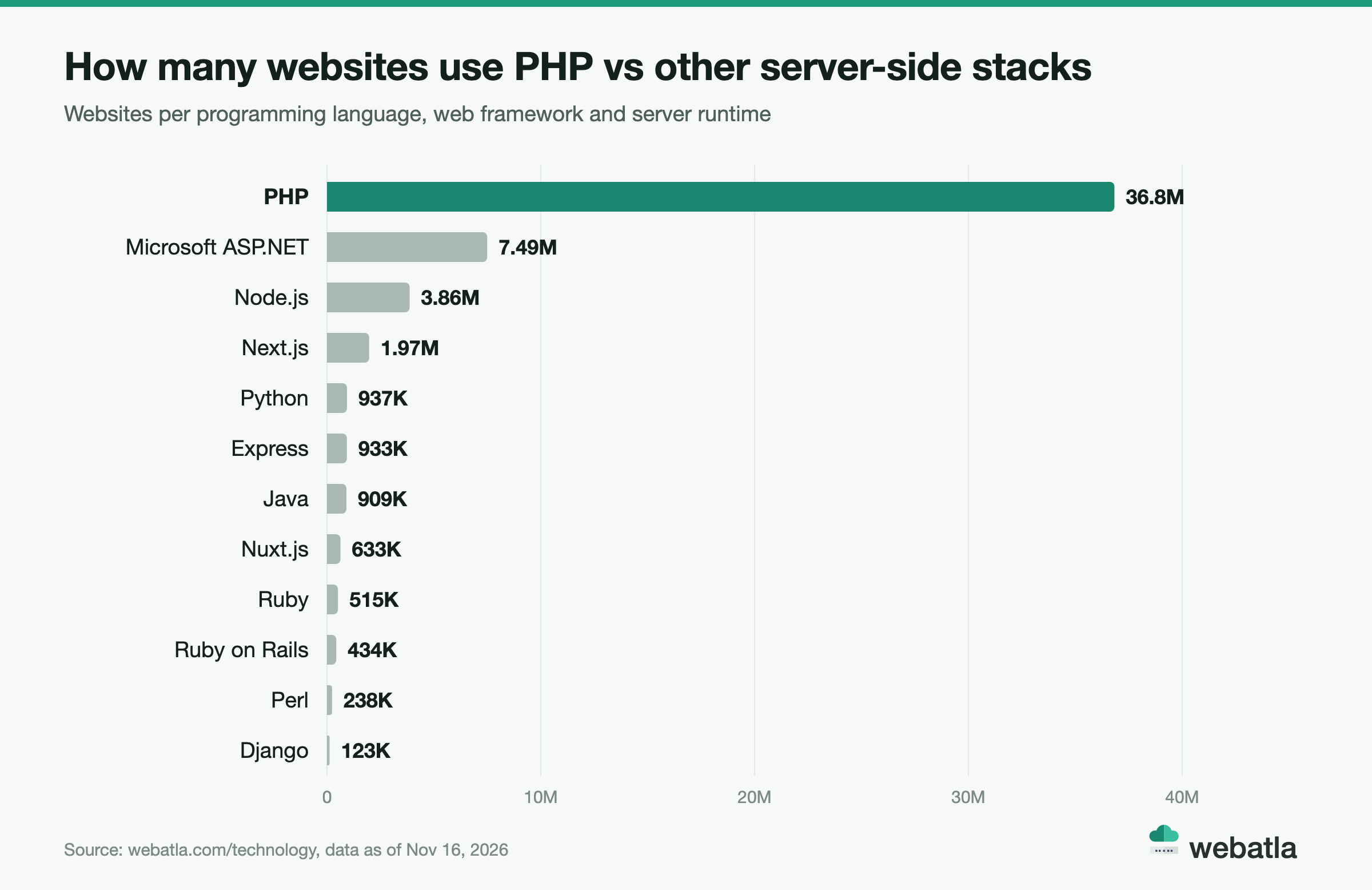
| Technology | Websites | Share of all websites | PHP has |
|---|---|---|---|
| PHP | 36,829,757 | 11.30% | |
| Microsoft ASP.NET | 7,490,202 | 2.30% | 4.9x more |
| Node.js | 3,863,899 | 1.19% | 9.5x more |
| Next.js | 1,973,502 | 0.61% | 19x more |
| Python | 937,123 | 0.29% | 39x more |
| Express | 932,791 | 0.29% | 39x more |
| Java | 908,606 | 0.28% | 41x more |
| Nuxt.js | 633,307 | 0.19% | 58x more |
| Ruby | 515,429 | 0.16% | 71x more |
| Ruby on Rails | 433,942 | 0.13% | 85x more |
| Perl | 237,611 | 0.07% | 155x more |
| Django | 122,755 | 0.04% | 300x more |
The peer group for market share is every technology that webatla files under Programming languages or Web frameworks: 96 technologies with 53.0 million detections between them. A site that runs two of them counts twice. Node.js is listed under Web servers on webatla, so it appears in the table above but stays out of this group.
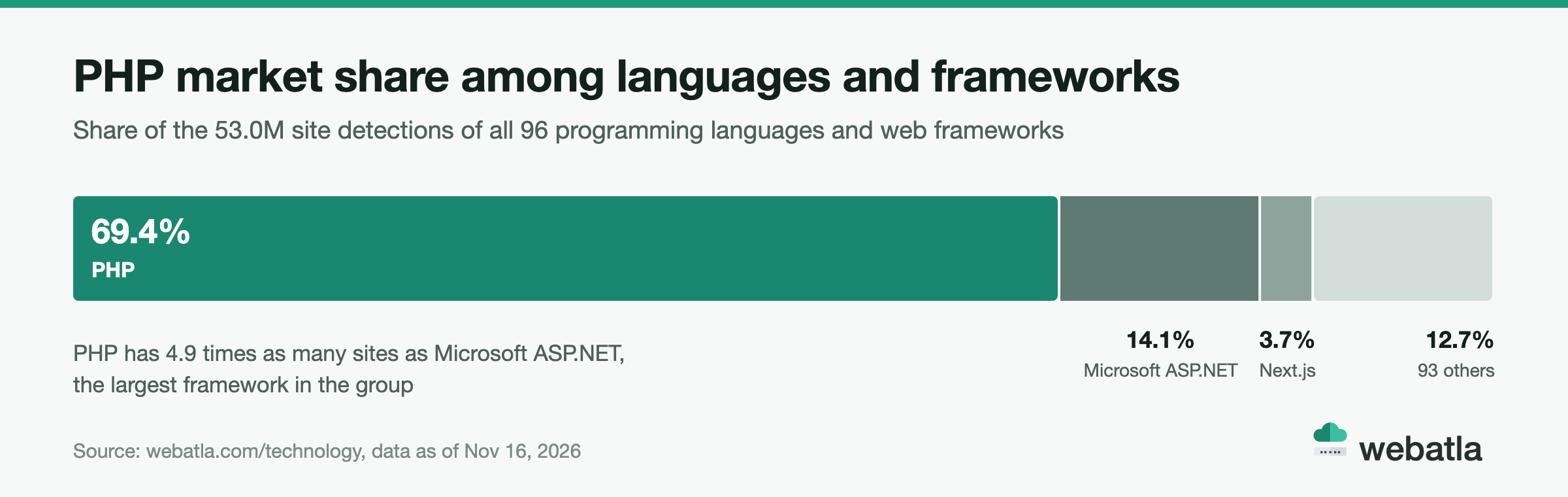
Three things stand out in the market share data.
PHP is bigger than everything else combined. The other 95 languages and frameworks in the group add up to 16.2 million detections. PHP alone has 36.8 million.
Microsoft ASP.NET is the only large rival. It holds 14.1% of the group. No other technology in the group reaches 4%.
The JavaScript stack is the one gaining. The counts of Node.js, Next.js, Express and Nuxt.js add up to 7.4 million. They are still far behind PHP, but they grew fastest over the last three years (more on that below).
PHP growth statistics: 2015 to 2026
At the end of 2015 PHP ran on 40.0 million sites. It peaked at 44.5 million in December 2017 and has drifted down since. In October 2026 the history model put PHP at 37.1 million sites.
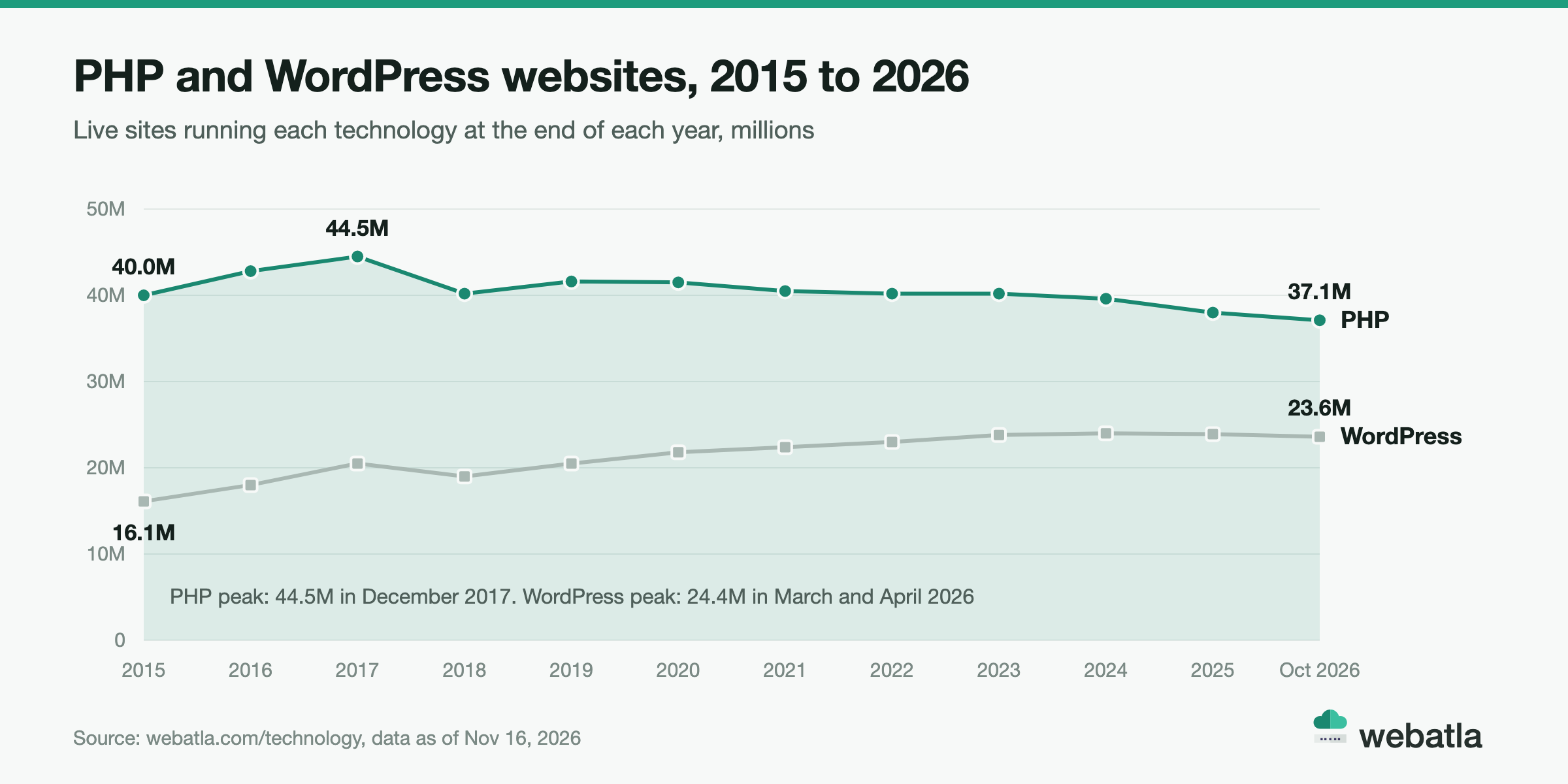
| Year | PHP sites at year end | Came in | Left | Net change |
|---|---|---|---|---|
| 2016 | 42.8M | 8.90M | 6.16M | +2.74M |
| 2017 | 44.5M | 8.93M | 7.22M | +1.71M |
| 2018 | 40.2M | 8.33M | 12.6M | -4.24M |
| 2019 | 41.6M | 10.7M | 9.31M | +1.39M |
| 2020 | 41.5M | 9.26M | 9.38M | -124K |
| 2021 | 40.5M | 7.81M | 8.79M | -978K |
| 2022 | 40.2M | 7.56M | 7.95M | -385K |
| 2023 | 40.2M | 8.07M | 8.04M | +27.3K |
| 2024 | 39.6M | 9.77M | 10.4M | -598K |
| 2025 | 38.0M | 10.2M | 11.8M | -1.57M |
| 2026, January to October | 37.1M | 8.14M | 9.08M | -941K |
The table splits into three periods.
2016 and 2017 were the last growth years. PHP added 4.45 million sites in two years and reached its all-time high.
2018 was the big break. 12.6 million sites left PHP that year, the most in the whole series, and the total fell by 4.24 million. 2019 won back 1.39 million, but the count never returned to the 2017 level.
Since 2020 PHP has lost ground almost every year. Net losses ranged from 124,000 in 2020 to 978,000 in 2021, then reached 1.57 million in 2025, the largest drop since 2018. 2023 was the one flat year, with a gain of 27,300 sites.
From the end of 2015 to October 2026 PHP is down 7.3%. From the 2017 peak it is down 16.6%.
WordPress grew while PHP shrank
The chart also shows WordPress, which webatla lists as PHP software. At the end of 2016 WordPress had 18.0 million sites, a count equal to 42% of the PHP total. By October 2026 WordPress had 23.6 million, equal to 64% of the PHP total.
So the gap between the two counts fell from 24.8 million sites to 13.5 million. Most likely, the PHP web outside WordPress (custom code, older CMS and smaller frameworks) is where most of the decline happened, while WordPress itself grew.
Is PHP growing or declining?
PHP is declining slowly. It changed by -7.6% from October 2023 to October 2026 and by -1.5% over the last 12 months. That is a gentle slope for a technology of this size, and it hides a lot of movement underneath.
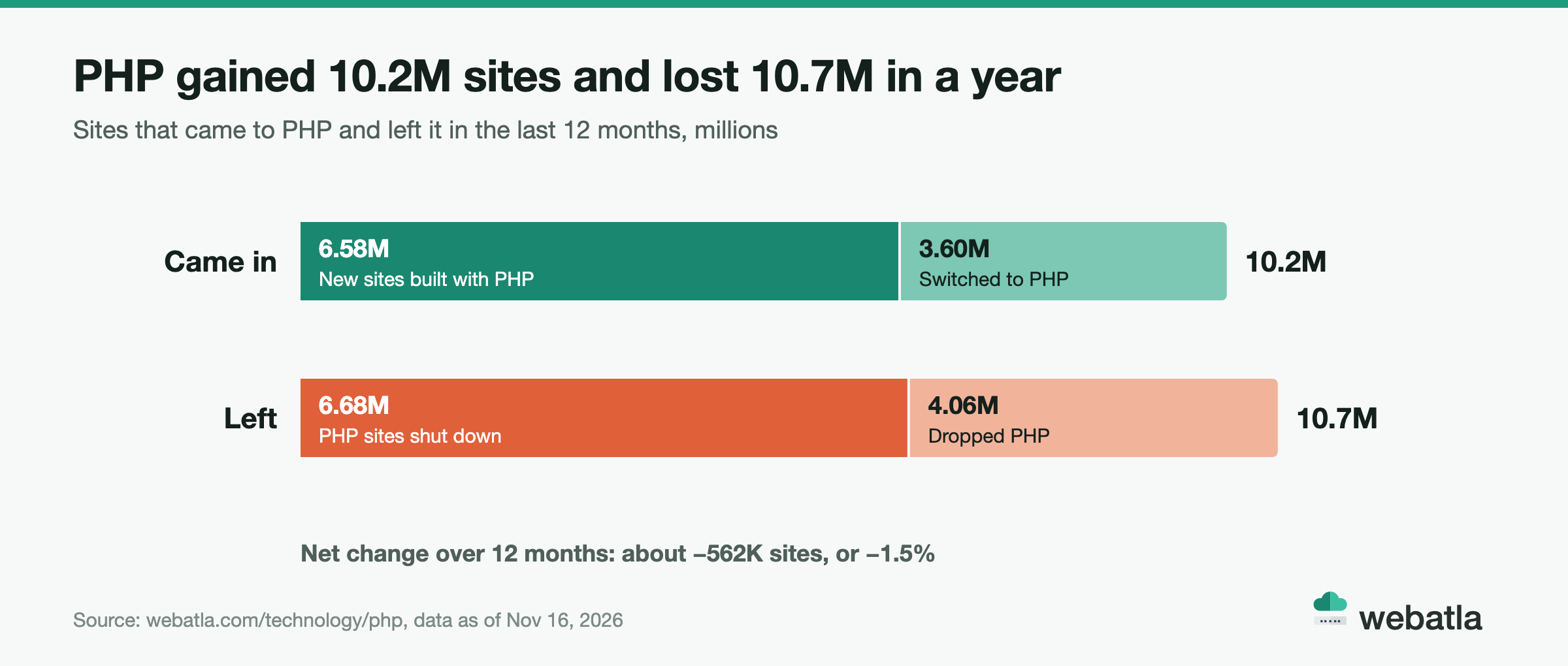
Over the last 12 months:
- 6.58 million new sites started with PHP. These are fresh websites that launched on it, about 18,000 a day.
- 3.6 million existing sites switched to PHP from another stack.
- 6.68 million PHP sites shut down. The domain expired or the site went offline.
- 4.06 million sites dropped PHP and moved to something else while staying online.
Two things follow from these numbers.
New launches and closures almost cancel out. 6.58 million new sites against 6.68 million closed ones is a gap of about 100,000. PHP is still the default for a huge number of new websites, most likely because the software people pick (WordPress first of all) runs on it.
PHP loses a little on switching. For every 100 sites that moved to PHP, about 113 moved away from it. Over the year that cost PHP roughly 460,000 sites, and it is the main source of the net loss of about 562,000 sites.
The turnover is large. 10.7 million sites left PHP in the last 12 months, equal to about 28% of the PHP base a year earlier. A list of PHP sites from a year ago is badly out of date.
PHP has a seasonal pattern
The monthly data shows a cycle you will not see in yearly totals. PHP gains sites in winter and loses them in summer.
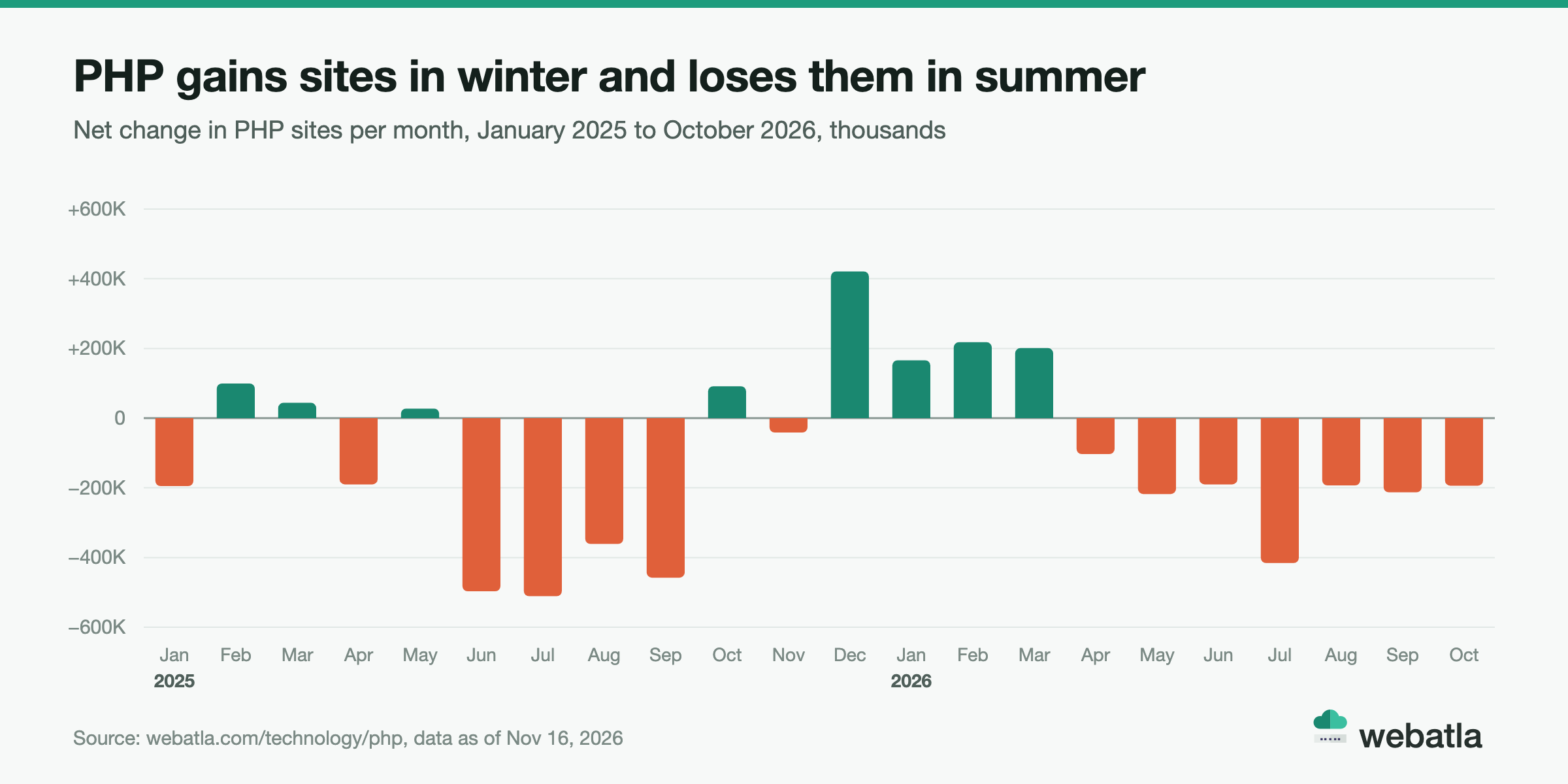
From December 2025 to March 2026 PHP added a net 1.01 million sites. December 2025 alone brought 421,000, the best month in the period. Then from April to October 2026 it lost a net 1.53 million. In 2025 the summer was even harsher: April to October cost PHP 1.90 million sites, with July 2025 the worst month at -511,000.
WordPress shows the same winter and summer cycle, which fits its weight inside the PHP base.
PHP vs Node.js, Python, Java and Microsoft ASP.NET: who is growing
PHP is the largest server-side technology by far, but not the fastest growing one. Here is how the main languages and frameworks changed over the last three years.
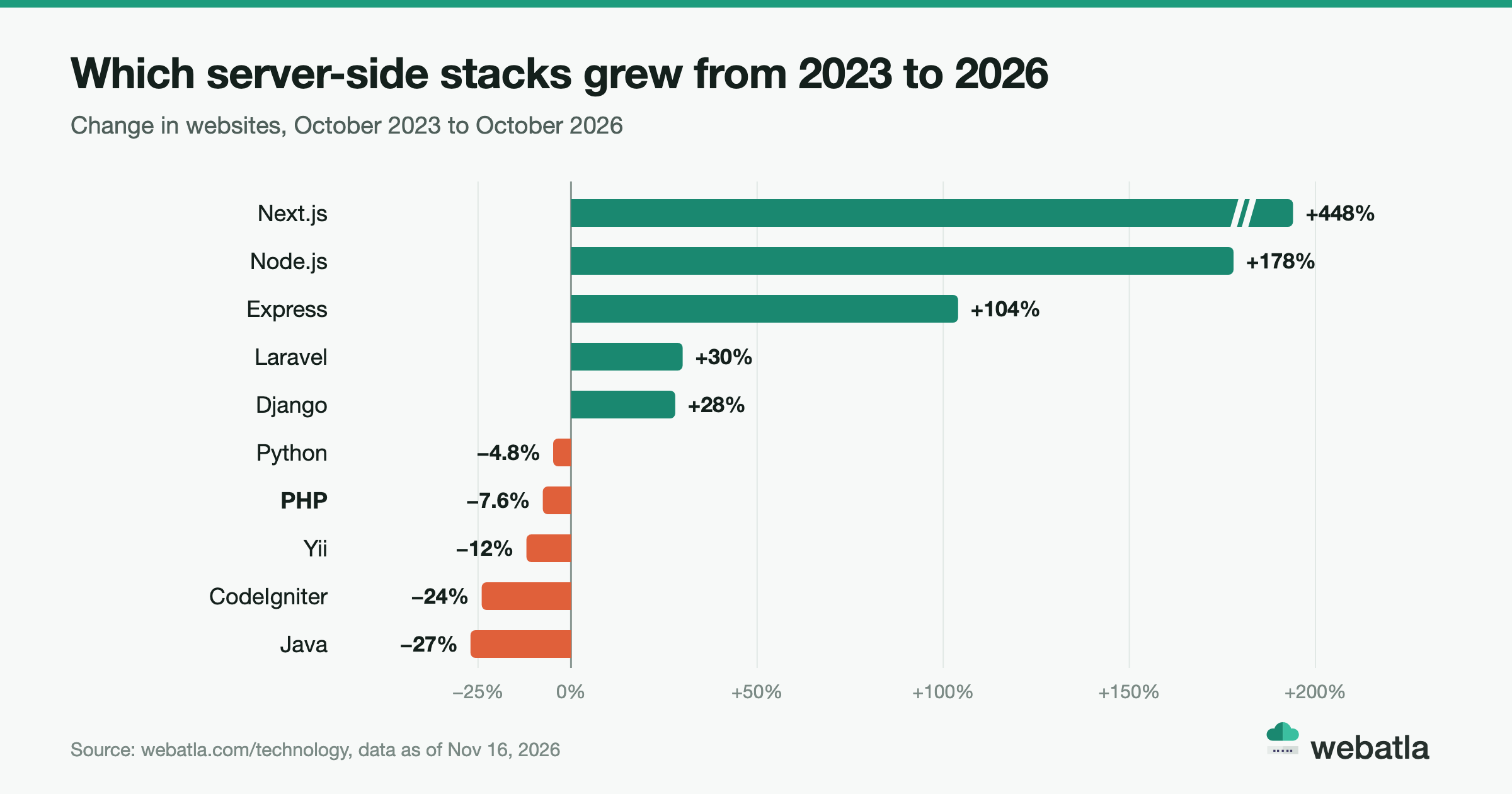
The longer view since 2016 shows the same direction:
| Technology | Sites, end of 2016 | Sites, October 2026 | Change since 2016 | Change, last 3 years |
|---|---|---|---|---|
| PHP | 42.8M | 37.1M | -13% | -7.6% |
| Node.js | 228K | 3.87M | +1,597% | +178% |
| Python | 1.41M | 915K | -35% | -4.8% |
| Java | 2.84M | 884K | -69% | -27% |
| Laravel | 183K | 521K | +185% | +30% |
| Django | 72.6K | 121K | +67% | +28% |
| CodeIgniter | 262K | 178K | -32% | -24% |
| Yii | 52.3K | 74.1K | +42% | -12% |
PHP vs Node.js. Node.js grew about 17 times since 2016 and +178% in the last three years. In the last 12 months 3.04 million sites came to Node.js and 1.81 million left. PHP still has 9.5 times as many sites, but Node.js is the clear winner of the period. Next.js, built on the same JavaScript stack, grew 448% in three years to 1,973,502 sites.
PHP vs Microsoft ASP.NET. Microsoft ASP.NET is the second largest server-side technology with 7,490,202 sites. webatla does not publish a history series for it, so the comparison here is today's file against today's file: PHP has 4.9 times as many.
PHP vs Python. Python is almost flat at -4.8% over three years and now runs on 937,123 sites. The Django framework grew 28% to 122,755.
PHP vs Java. Java lost 69% of its sites since 2016 and 27% in the last three years. It now runs on 908,606 sites, about one fortieth of the PHP count.
PHP vs Ruby. Ruby has 515,429 sites and Ruby on Rails 433,942. Both lost a large share over the two years that webatla tracks for them: Ruby -30% and Ruby on Rails -25% from October 2024 to October 2026.
Inside PHP the frameworks moved in different directions. Laravel grew 30% in three years and almost tripled since 2016. Older frameworks such as CodeIgniter (-24%) and Yii (-12%) are losing sites.
What runs on PHP: WordPress, Laravel, Joomla and more
PHP itself is rarely the reason a site runs PHP. The owner picks a CMS, a shop or a framework, and the language comes with it. That is why the software layer on top of PHP says much more about a site than the language alone.
WordPress is the giant. It runs on 23,491,961 sites, a count equal to 63.8% of the PHP base, almost two in every three. WooCommerce, the WordPress shop plugin, adds 3,344,511 stores, equal to 9.1% of the PHP base.
After WordPress and WooCommerce the numbers drop fast. No other PHP application reaches 1.5% of the PHP base.
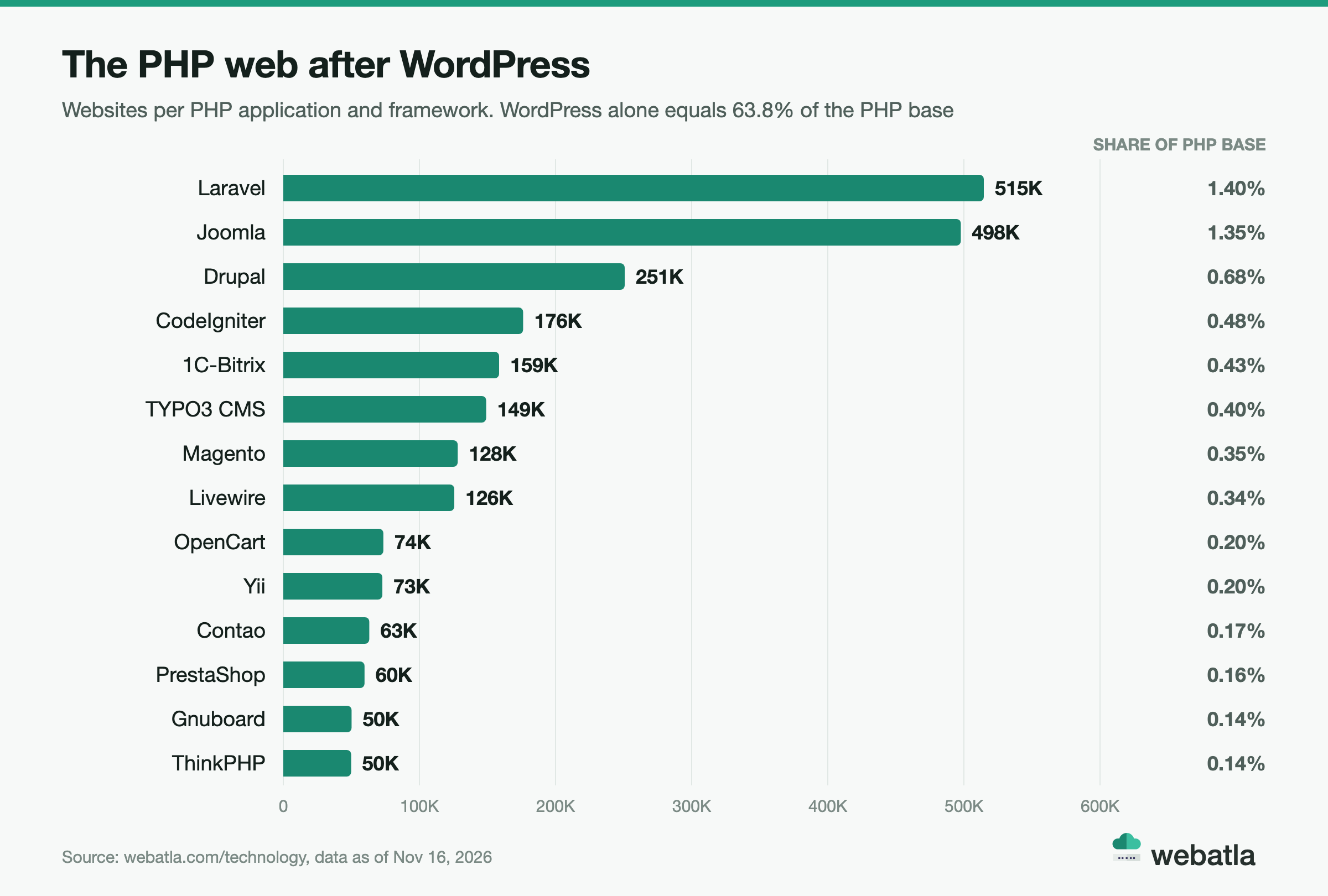
| Software | Type | Websites | Equal to % of PHP base | Change, Oct 2023 to Oct 2026 |
|---|---|---|---|---|
| WordPress | CMS | 23,491,961 | 63.8% | +0.1% |
| WooCommerce | Ecommerce | 3,344,511 | 9.1% | +1.3% |
| Laravel | Web framework | 514,657 | 1.40% | +30% |
| Joomla | CMS | 497,752 | 1.35% | -44% |
| Drupal | CMS | 250,783 | 0.68% | -32% |
| CodeIgniter | Web framework | 176,219 | 0.48% | -24% |
| 1C-Bitrix | CMS, Ecommerce | 158,539 | 0.43% | -19% |
| TYPO3 CMS | CMS | 149,055 | 0.40% | -27% |
| Magento | Ecommerce | 128,122 | 0.35% | +5.3% |
| Livewire | Web framework | 125,589 | 0.34% | +205% |
| OpenCart | Ecommerce | 73,523 | 0.20% | -8.7% |
| Yii | Web framework | 72,726 | 0.20% | -12% |
| Contao | CMS | 63,203 | 0.17% | -21% |
| PrestaShop | Ecommerce | 59,682 | 0.16% | -52% |
WordPress and the 14 applications in the chart above add up to a count equal to about 70% of the PHP base. The other 30% is most likely custom PHP code, smaller applications and sites that hide which application they run.
PHP frameworks
Laravel is the most popular PHP framework, with 514,657 sites. It grew 30% in three years, and Livewire, another PHP framework webatla tracks, tripled to 125,589 sites (+205%). Further down the list, ThinkPHP has 49,833 sites (-39%), Nette Framework 36,839 (-20%), Symfony 30,424 and CakePHP 16,536.
PHP content management systems
The classic PHP CMS are shrinking. Joomla lost 44% of its sites in three years and 79% since 2016. Drupal lost 32% in three years. TYPO3 CMS (-27%), Contao (-21%), MODX (31,268 sites, -22%) and Craft CMS (31,146 sites, -16%) all point the same way. Only WordPress held its ground.
PHP e-commerce
Shops are the most mixed group. Magento is up 5.3% over three years and 34% in the last 12 months, to 128,122 stores. PrestaShop halved (-52%), and OpenCart fell 8.7%. WooCommerce is flat at +1.3% and remains by far the largest PHP shop software.
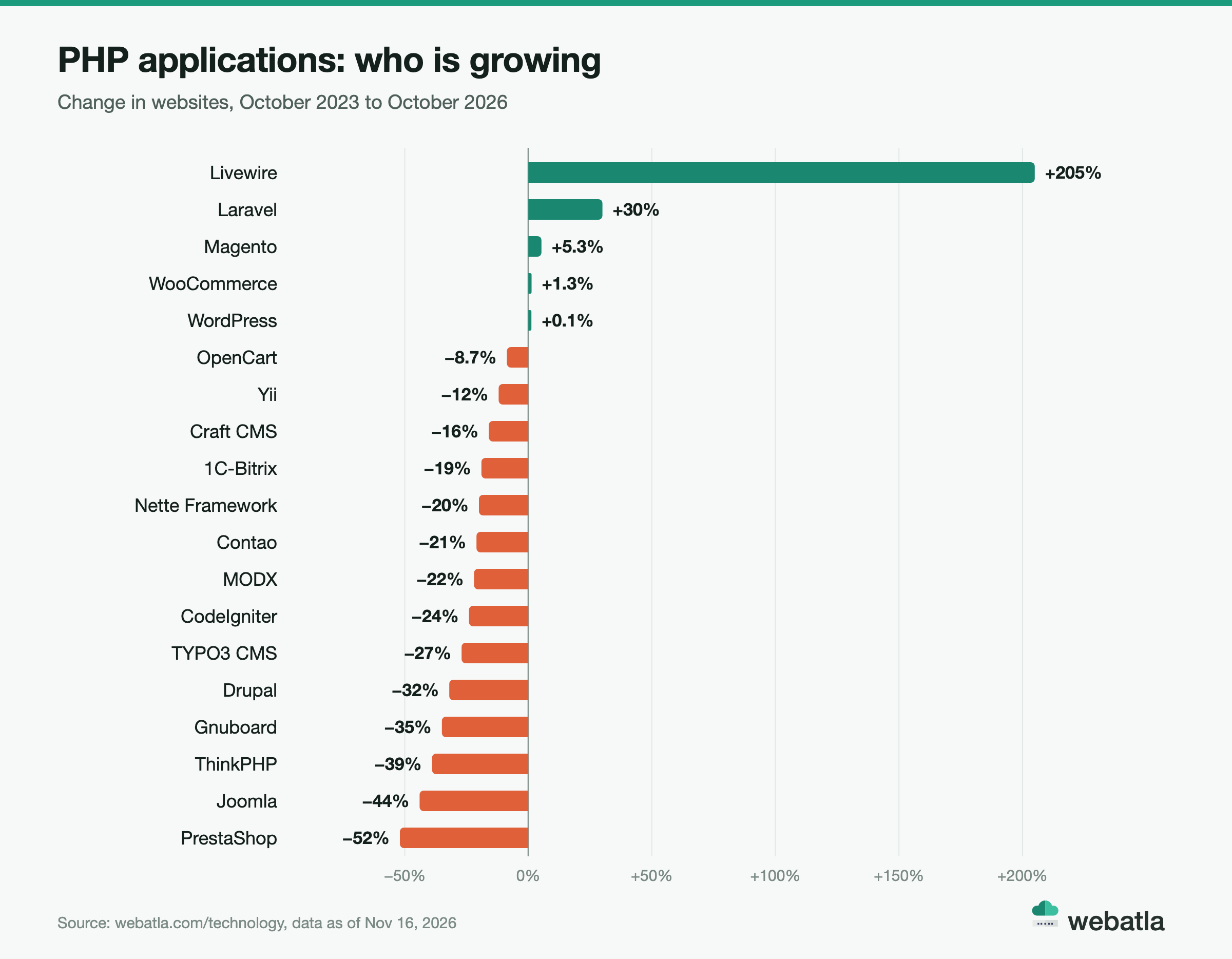
Other PHP software in the index includes Nextcloud (28,788 sites), Moodle (22,532), Shopware (19,060), phpBB (8,527), XenForo (8,295) and MediaWiki (8,076).
PHP version statistics
The version is where PHP data gets sharp. About 14.4 million PHP sites, roughly 39% of the total, expose which PHP release they run. webatla sees 714 distinct version strings in production. The PHP page lists the 25 most common ones, which cover 85.7% of sites with a known version.
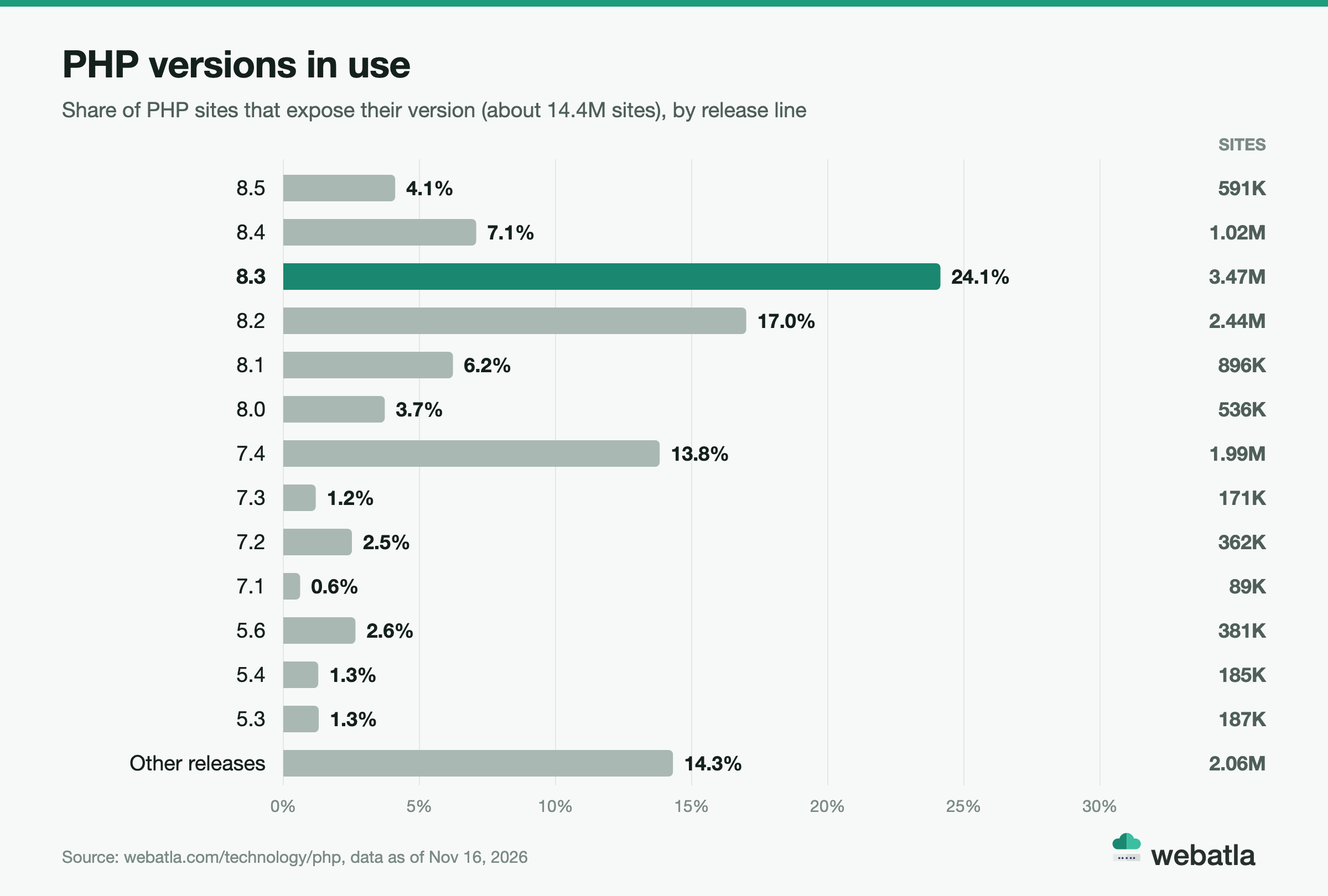
Grouped by major version, the 25 most common releases give these minimum shares:
- PHP 8.x runs on at least 62.3% of sites that show a version, 8,951,232 sites. The 8.3 line leads with 24.1%, then 8.2 with 17.0%.
- PHP 7.x runs on at least 18.2%, 2,608,189 sites. Almost all of them are on 7.4 (13.8%).
- PHP 5.x runs on at least 5.2%, 752,114 sites, led by 5.6 (2.6%).
The most common single releases:
| Release | Sites | Share |
|---|---|---|
| 8.3.36 | 2,372,491 | 16.5% |
| 7.4.33 | 1,867,498 | 13.0% |
| 8.2.35 | 1,567,627 | 10.9% |
| 8.3.35 | 937,411 | 6.5% |
| 8.1.34 | 895,541 | 6.2% |
| 8.2.34 | 741,175 | 5.2% |
| 8.4.27 | 707,513 | 4.9% |
| 8.5.12 | 473,260 | 3.3% |
| 5.6.40 | 380,750 | 2.6% |
| 8.0.30 | 366,106 | 2.5% |
The second line of that table is the headline. 7.4.33, a release of the 7.x line, is the second most used PHP version on the web, with 1,867,498 sites. More sites run it than any single release of 8.2, 8.4 or 8.5.
End-of-life PHP versions: a security and hosting signal
The PHP project no longer ships security fixes for any 5.x or 7.x release, and the 8.0 and 8.1 lines are past their support window as well. A site on an unsupported interpreter does not get security patches, whatever runs on top of it.
From the 25 most common releases alone:
- 3,360,303 sites run PHP 7.x or 5.x, 23.4% of sites with a known version.
- 4,791,656 sites run 5.x, 7.x, 8.0 or 8.1, about one third of sites with a known version.
- 380,750 sites still run 5.6.40, and four more 5.3 and 5.4 releases add another 371,364.
These are floors, since another 2.06 million sites run releases outside the top 25. For hosting companies the outdated tail is a migration queue, and for security and maintenance services it is a ready list of sites that need work.
PHP usage by country
Country here means where the site's server is, by IP address, not where the owner lives. Shares of PHP sites are of sites with a known server country.
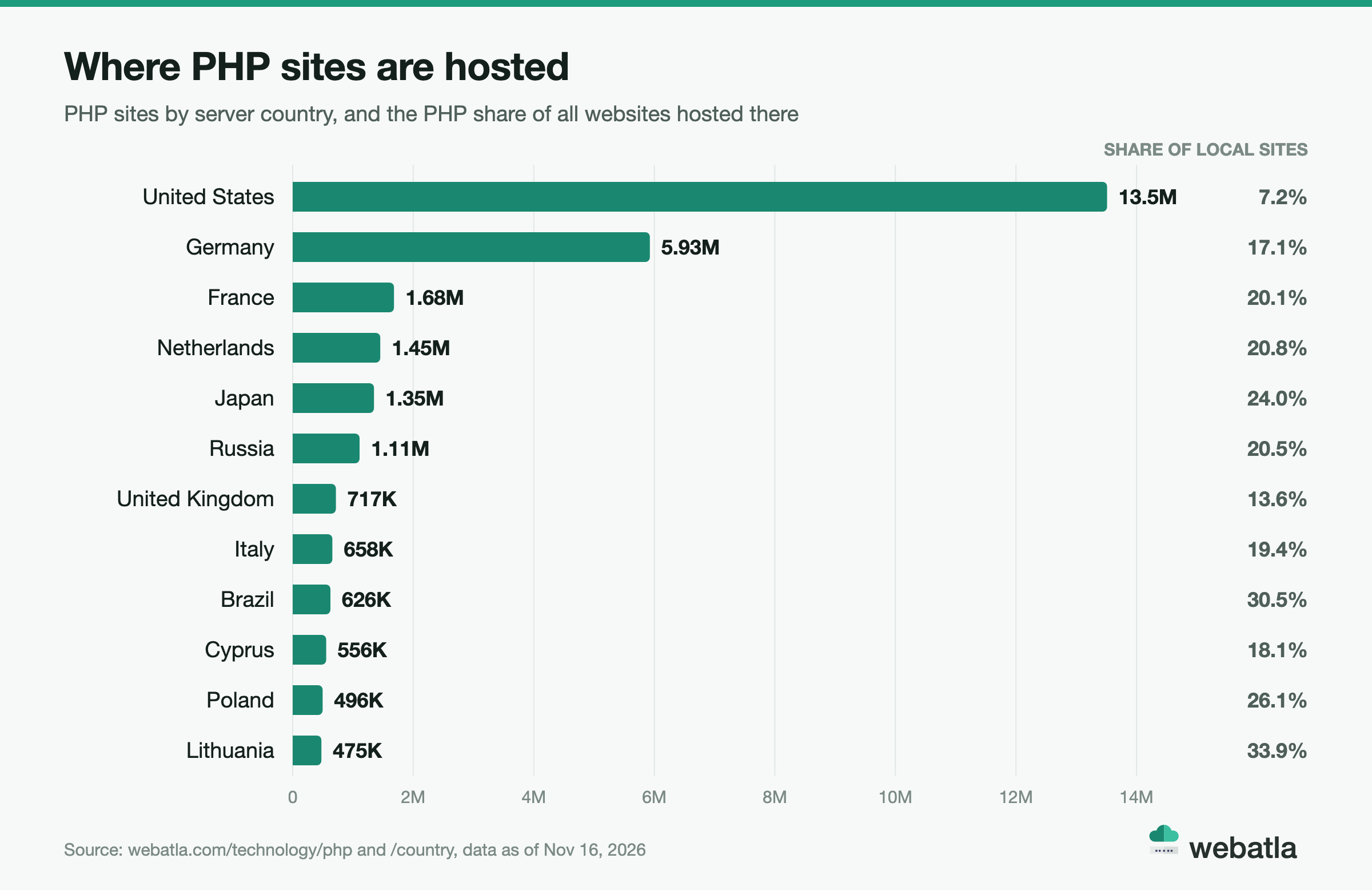
| Hosting country | PHP sites | Share of PHP sites | PHP share of local websites |
|---|---|---|---|
| United States | 13,511,543 | 38.0% | 7.2% |
| Germany | 5,925,845 | 16.6% | 17.1% |
| France | 1,680,085 | 4.7% | 20.1% |
| Netherlands | 1,452,722 | 4.1% | 20.8% |
| Japan | 1,348,794 | 3.8% | 24.0% |
| Russia | 1,110,113 | 3.1% | 20.5% |
| United Kingdom | 717,344 | 2.0% | 13.6% |
| Italy | 658,264 | 1.8% | 19.4% |
| Brazil | 626,362 | 1.8% | 30.5% |
| Cyprus | 555,961 | 1.6% | 18.1% |
| Poland | 496,162 | 1.4% | 26.1% |
| Lithuania | 475,414 | 1.3% | 33.9% |
| Sweden | 443,934 | 1.2% | 38.9% |
| India | 419,924 | 1.2% | 26.3% |
The United States hosts 38.0% of PHP sites, 13.5 million of them. Germany is second with 5.93 million, more than France, the Netherlands, Japan and Russia combined.
The last column shows how common PHP is among all websites hosted in each country, and the order changes. In the US only 7.2% of hosted websites run PHP, because US servers host 187 million websites, 57% of the whole web. In Brazil the share is 30.5%, in Sweden 38.9% and in Iran 41.0% (304,280 of 742,715 hosted websites). Canada is at the other end with 2.9%.
Russia stands out against WordPress. 1,110,113 PHP sites are hosted there, but only 433,598 WordPress sites, a sign that most PHP sites on Russian servers run something other than WordPress.
PHP by domain extension
43.7% of PHP sites use a .com domain, 16.1 million sites. Germany's .de is a distant second.
| TLD | PHP sites | Share |
|---|---|---|
| .com | 16,090,068 | 43.7% |
| .de | 2,175,954 | 5.9% |
| .org | 1,309,487 | 3.6% |
| .ru | 1,182,820 | 3.2% |
| .net | 950,259 | 2.6% |
| .uk | 899,418 | 2.4% |
| .nl | 882,805 | 2.4% |
| .br | 882,652 | 2.4% |
| .fr | 793,803 | 2.2% |
| .it | 591,885 | 1.6% |
The .ru extension ranks fourth for PHP but only tenth for WordPress, with 387,746 WordPress sites. Two newer extensions made the top 25: .shop with 272,300 PHP sites and .online with 246,826.
The stack around PHP
PHP never runs alone. A few counts from the same index help place it:
- Apache HTTP Server runs on 39,735,437 websites and Nginx on 72,864,210.
- LiteSpeed runs on 5,767,526 sites, up 17% in three years.
- MySQL runs on 24,460,929 sites and is flat at -0.7% over three years.
Every row of the PHP file carries the full detected stack, so the web server, database and CMS sit next to the PHP version for each site.
What these PHP statistics mean for business
A count of 36.8 million is a headline. The value is in the segments inside it, and each kind of company that sells to PHP site owners looks for a different one.
Hosting providers care about versions and location. At least 4.79 million sites run a PHP line that no longer gets security fixes, and 7.4.33 alone is on 1,867,498 sites. Germany hosts 5.93 million PHP sites and the United States 13.5 million. 4.06 million sites dropped PHP in a year and 6.68 million shut down, and many of those moves end or change a hosting account.
Upgrade, security and maintenance services start from the same version data. 752,114 sites still run PHP 5.x and 2,608,189 run 7.x. Each of them can be listed by domain, IP, hosting country and the CMS on top.
Agencies look for sites that are about to be rebuilt. Joomla lost 44% of its sites in three years, Drupal 32% and PrestaShop 52%. Joomla and Drupal still run on 748,535 sites between them, and many of those owners will be choosing what comes next.
Framework and developer tool vendors follow Laravel. It runs on 514,657 sites and grew 30% in three years, while Livewire tripled.
E-commerce services go to the shop layer. WooCommerce runs on 3,344,511 stores, Magento on 128,122 (+34% in 12 months), OpenCart on 73,523 and PrestaShop on 59,682. All of them can be filtered by country, TLD and the rest of their stack.
Analysts and investors follow the flows. More than a quarter of the PHP base turns over every year, the count rises in winter and falls in summer, and JavaScript stacks keep growing next to it. That is visible only when you compare the full list over time.
All of these questions are filters over the same full list. You run them on your own copy of the data, as narrow as you need, and you can keep yesterday's file to see what changed.
How webatla counts PHP sites
A few notes on method, so you can read the numbers correctly.
- The count. 36,829,757 is every website where PHP was detected in today's file, whatever its HTTP status. The file is rebuilt every day, and each row is one domain.
- The base. "Websites" means the 325,803,430 domains that answer with a web server. Market share against all websites uses this base. Market share among languages uses the sum of site counts of the 24 programming languages (40.1 million) or of the 96 programming languages and web frameworks (53.0 million) on webatla.
- History. Yearly and monthly figures come from webatla's monthly history of active sites, anchored to the webatla census of October 2026. From November 2026 the counting model changed, so compare months with months and today's file with today's file.
- Software on PHP. "Equal to X% of the PHP base" is the software's site count divided by the PHP site count.
- Versions. Shares are of sites that expose their PHP version, about 14.4 million. Major version totals add up the 25 most common releases, so they are minimums.
- Countries. The country is where the server is, by IP address.
Servers can hide the PHP header, and some sites hide PHP completely. The numbers describe what is observable on the web, measured the same way every day.
Frequently asked questions about PHP statistics
How many websites use PHP?
36,829,757 websites use PHP as of November 16, 2026, according to the webatla index. The count is refreshed every day on the PHP technology page.
What percentage of websites use PHP?
11.30% of all 325.8 million websites run PHP, about one in nine. Among all programming language detections, PHP accounts for 91.7%.
What is the PHP market share in 2026?
PHP holds 69.4% of all detections of the 96 programming languages and web frameworks webatla tracks in November 2026. Microsoft ASP.NET follows with 14.1% and Next.js with 3.7%.
Is PHP declining in 2026?
Yes, slowly. PHP changed by -7.6% from October 2023 to October 2026 and by -1.5% in the last 12 months. It still gains about 18,000 new sites a day, but slightly more sites leave it than arrive.
Which PHP version is most used?
8.3.36, on 16.5% of PHP sites that show their version. The 8.3 line as a whole runs on 24.1%. The second most used release is 7.4.33, with 1,867,498 sites.
How many websites still run PHP 7 or PHP 5?
At least 2,608,189 sites run PHP 7.x and 752,114 run PHP 5.x. Together that is 23.4% of PHP sites with a known version.
What percentage of PHP sites run WordPress?
WordPress runs on 23,491,961 sites, a count equal to 63.8% of the PHP base. Almost two in three PHP sites are WordPress sites.
What is the most popular PHP framework?
Laravel, on 514,657 websites. It grew 30% from October 2023 to October 2026. CodeIgniter is second among PHP frameworks with 176,219 sites.
Which country has the most PHP websites?
The United States, with 13,511,543 PHP sites hosted there, 38.0% of PHP sites with a known server country. Germany is second with 5,925,845.
Get the full list of PHP websites →
Every PHP number in this article comes from one file. The webatla PHP list holds all 36,829,757 websites running PHP, one row per site, and it is rebuilt every day.
Each row gives you the domain, the full technology stack with versions (including the exact PHP release), the IP address, hosting country, HTTP status, social profiles, PageRank and Harmonic rank, and the domain's creation and expiry dates. That means you can go far past the headline count:
- every site still running PHP 7.4 or 5.6, by hosting country,
- every Laravel, Joomla or Drupal site and the PHP version under it,
- every PHP shop on WooCommerce, Magento, OpenCart or PrestaShop,
- every PHP site that appeared since yesterday's file.
The PHP list comes with the Technologies dataset for €159 a month: 313,947,451 websites, 3,000+ technologies, and ready files by technology, country and TLD. You can also download a free 20-row preview to see the format.