Quick Facts: Odoo Statistics in November 2026
- 104,967 websites use Odoo as of November 16, 2026. This is the live count on the Odoo technology page, rebuilt every day.
- Odoo runs on 0.032% of the 325.8 million websites webatla tracks, about one site in every 3,100.
- Among store platforms, Odoo is fifth by number of sites, after WooCommerce, Shopify, 1C-Bitrix and Magento.
- Below WooCommerce and Shopify, Odoo holds 14.2% of the next ten store platforms combined.
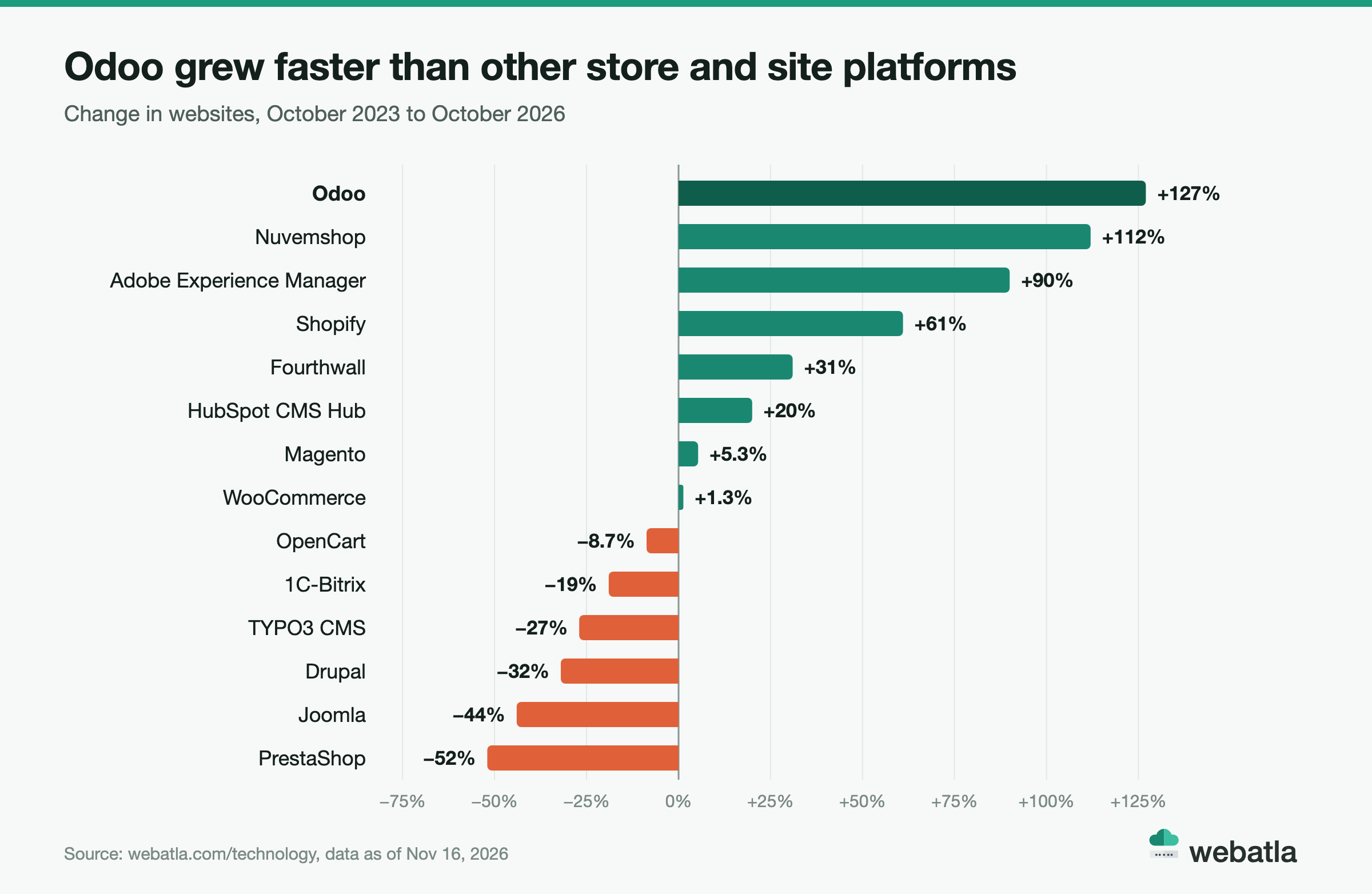
- Odoo grew +127% from October 2023 to October 2026, faster than any other store or site platform compared in this article.
- Over the last 12 months the count changed by +19%. 45.7K sites came to Odoo and 29K left.
- 22.7K new sites launched on Odoo in that year, about 62 a day, and another 23K existing sites switched to it.
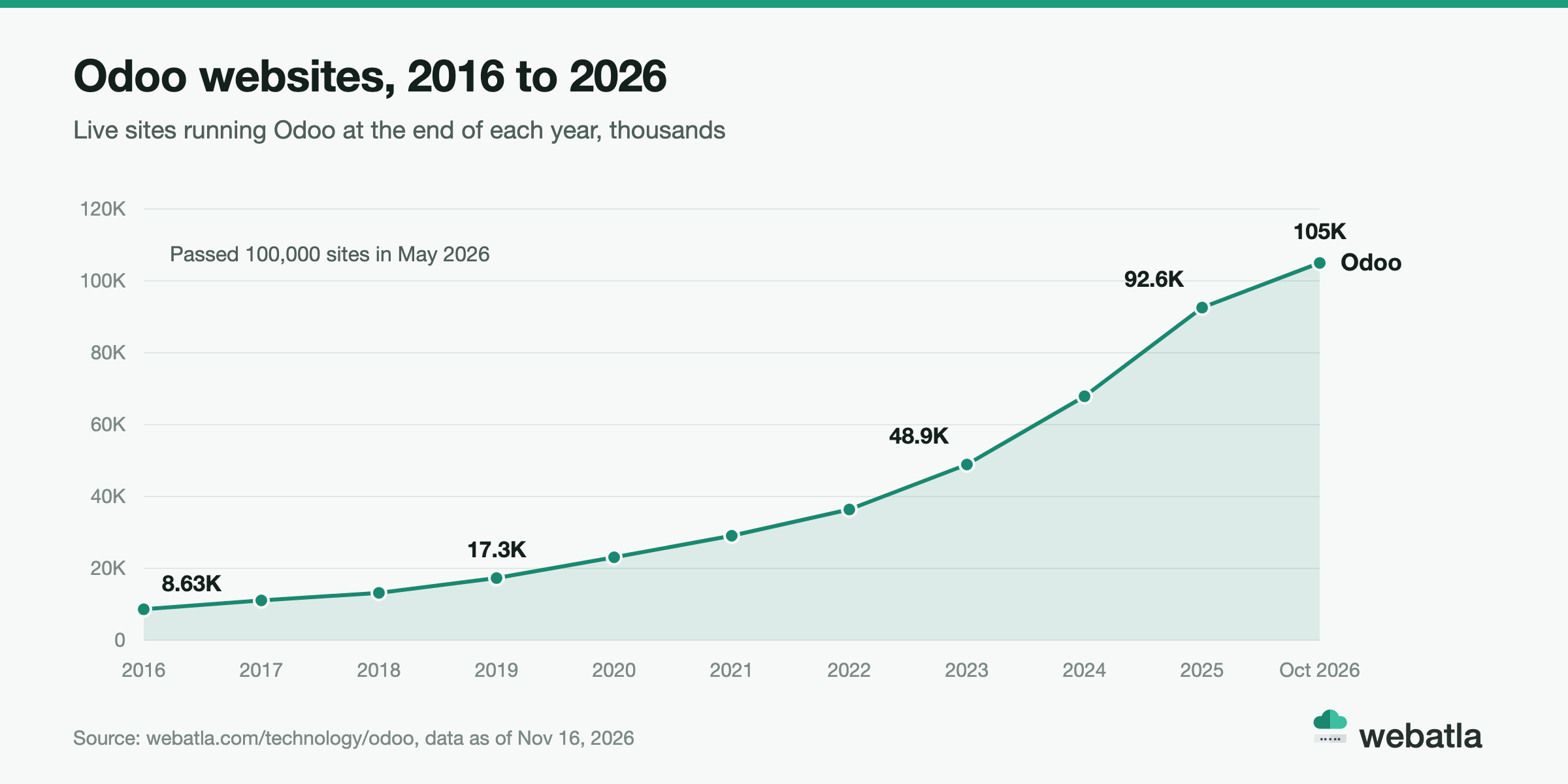
- The history model counted 8.63K Odoo sites at the end of 2016 and 105K in October 2026, 12 times as many.
- Odoo passed OpenCart in July 2025 and PrestaShop in August 2025.
- Odoo runs on about 20 times as many websites as Salesforce Commerce Cloud, SAP Commerce Cloud, NetSuite and Microsoft Dynamics 365 Commerce put together.
- 40.6% of Odoo sites are hosted in the United States and 24.4% in France, a country that hosts only 2.57% of all websites.
- Growth slowed in 2026. The monthly net gain fell from about 1,800 sites in January to 586 in October.
Every number in this article comes from the webatla index as of November 16, 2026. webatla scans 325.8 million websites, records the technology each one runs and publishes the result as daily files. Below you will find how many websites use Odoo, how its market share compares with Magento, PrestaShop, Shopify and the big business suites, how fast it has grown since 2016, why that growth slowed in 2026, and where Odoo sites are hosted.
How many websites use Odoo in 2026?
Odoo runs on 104,967 websites as of November 16, 2026. That is every website where webatla detected Odoo in today's scan, counted one domain per site.
Odoo is a business management suite with its own website and shop modules. It is written in Python and published by Odoo S.A. under the LGPL since 2005. Most of an Odoo installation is invisible from the outside, because the invoices, the stock and the payroll sit behind a login. What webatla sees is the public edge: a storefront, a customer portal, a booking page or a company site built with the website module. Behind most of the 104,967 domains is a business that runs at least part of its operations on Odoo.
To put 104,967 in perspective:
- It is 82% of the Magento count (128,122) and 1.4 times the OpenCart count (73,523).
- It is equal to 11.2% of all websites where webatla detects Python.
- It is about one website in every 3,100 online.
What percentage of websites use Odoo?
0.032% of all websites run Odoo. The base here is the full web as webatla sees it: 325.8 million websites, including parked domains, placeholder pages, redirects and sites that run no CMS at all. You may see higher Odoo percentages quoted elsewhere. Those figures usually come from a smaller base, such as the most visited sites only.
A narrower base shows where Odoo really stands:
| Base | Websites | Odoo share |
|---|---|---|
| All websites webatla tracks | 325,803,430 | 0.032% |
| The 40 largest CMS, site builders and hosted shops | 51,722,518 | 0.20% |
| The 12 largest store platforms | 7,336,224 | 1.43% |
| The same 12 without WooCommerce and Shopify | 740,063 | 14.2% |
Among general site platforms Odoo ranks 26th of 40. Among store platforms it ranks fifth. WooCommerce and Shopify hold 89.9% of the store group between them. Take those two out and Odoo has about one site in seven of what is left.
Odoo market share vs Magento, PrestaShop and other store platforms
The store market on the web has two giants and a long middle. WooCommerce and Shopify each have about 31 times as many sites as Odoo. Below them sits a group of platforms with 30,000 to 160,000 sites each. Odoo is third in that group, after 1C-Bitrix and Magento.
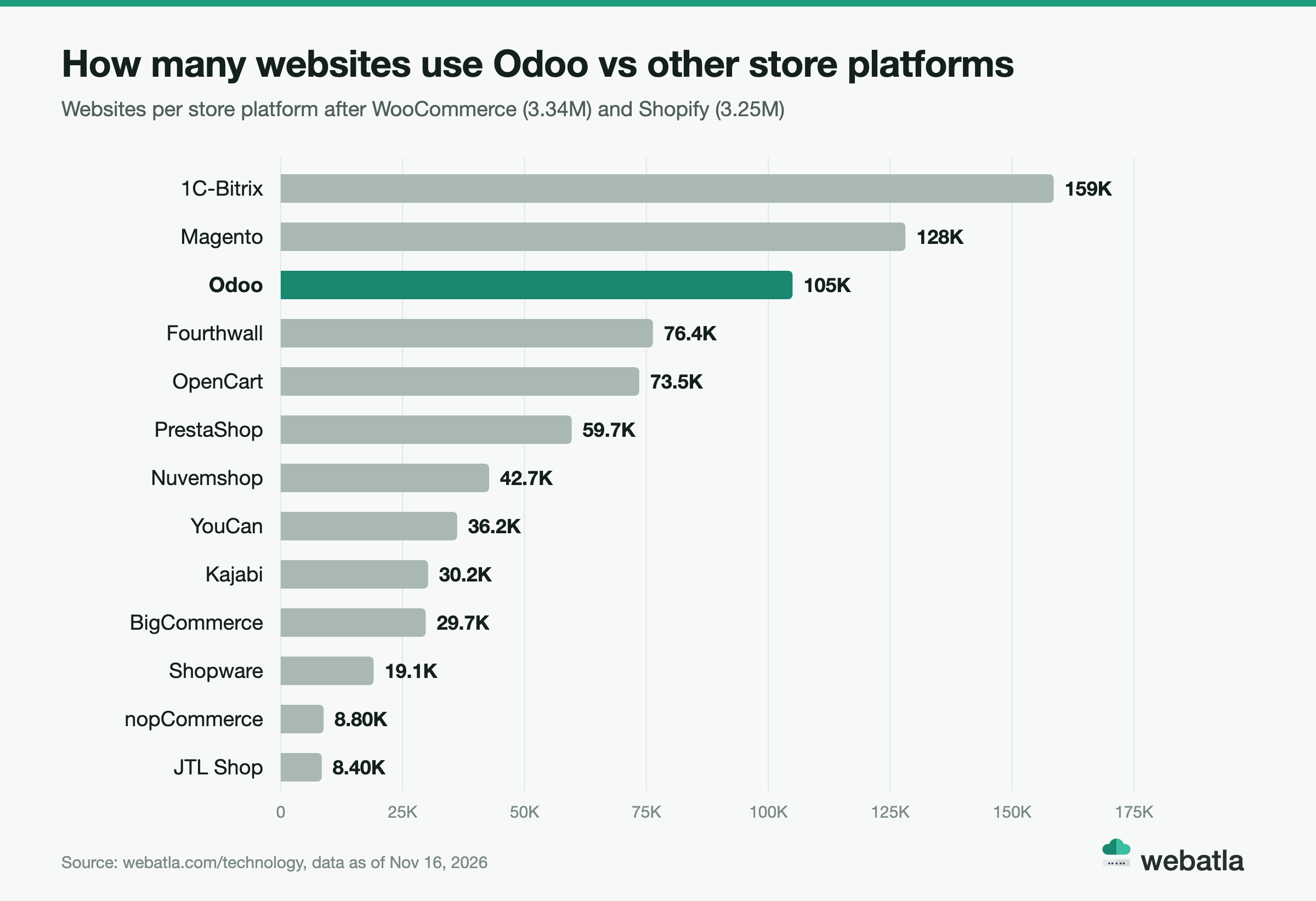
| Platform | Websites | Share of all websites | Share of the 12 store platforms | Change, Oct 2023 to Oct 2026 |
|---|---|---|---|---|
| WooCommerce | 3,344,511 | 1.027% | 45.6% | +1.3% |
| Shopify | 3,251,650 | 0.998% | 44.3% | +61% |
| 1C-Bitrix | 158,539 | 0.049% | 2.16% | -19% |
| Magento | 128,122 | 0.039% | 1.75% | +5.3% |
| Odoo | 104,967 | 0.032% | 1.43% | +127% |
| Fourthwall | 76,353 | 0.023% | 1.04% | +31% |
| OpenCart | 73,523 | 0.023% | 1.00% | -8.7% |
| PrestaShop | 59,682 | 0.018% | 0.81% | -52% |
| Nuvemshop | 42,729 | 0.013% | 0.58% | +112% |
| YouCan | 36,195 | 0.011% | 0.49% | n/a |
| Kajabi | 30,222 | 0.009% | 0.41% | n/a |
| BigCommerce | 29,731 | 0.009% | 0.41% | n/a |
The store group is the 12 largest platforms in webatla's Ecommerce category. It leaves out the generic cart marker and the shop features of site builders (Squarespace Commerce and Wix eCommerce), which are counted with their builders.
Three things stand out.
Odoo is the fastest grower in the group. Of the platforms with a three-year history, only Nuvemshop comes close at +112%. Shopify grew 61%. The other platforms in Odoo's size range are flat or shrinking: Magento +5.3%, OpenCart -8.7%, 1C-Bitrix -19% and PrestaShop -52%.
Odoo has left two older shop engines behind. It now has 1.43 times as many sites as OpenCart and 1.76 times as many as PrestaShop. Three years ago both were larger than Odoo.
Magento is the next name above Odoo, and it pulled away in 2026. Today's files show Magento at 128,122 and Odoo at 104,967, a gap of 23,155 sites. The growth section below shows how close the two came in April 2026.
Odoo vs Salesforce, SAP, NetSuite and Microsoft
Odoo is also a CRM and ERP, so it is fair to set it against the commerce products of the large business software vendors. On the public web the gap is wide.
| Product | Websites | Odoo has |
|---|---|---|
| Odoo | 104,967 | |
| Salesforce Commerce Cloud | 3,673 | 29x more |
| SAP Commerce Cloud | 1,352 | 78x more |
| NetSuite | 220 | 477x more |
| Microsoft Dynamics 365 Commerce | 26 | 4,037x more |
Together the four products appear on 5,271 websites. Odoo appears on 19.9 times as many. A website count does not measure customers or revenue. It measures how often a business suite reaches the public web, and by that measure Odoo is far ahead of the large vendors.
Odoo growth statistics: 2016 to 2026
webatla's history for Odoo starts in May 2016, when the model counted 6.15K sites. By the end of 2016 the count was 8.63K. By the end of 2025 it was 92.6K, almost 11 times as many in nine years.
| Year | Odoo sites at year end | Came in | Left | Net change | Growth in the year |
|---|---|---|---|---|---|
| 2017 | 11.1K | 5.01K | 2.51K | +2.51K | +29% |
| 2018 | 13.2K | 5.36K | 3.31K | +2.05K | +19% |
| 2019 | 17.3K | 7.05K | 2.90K | +4.15K | +31% |
| 2020 | 23.1K | 9.55K | 3.82K | +5.73K | +34% |
| 2021 | 29.1K | 10.5K | 4.42K | +6.06K | +26% |
| 2022 | 36.4K | 12.0K | 4.79K | +7.26K | +25% |
| 2023 | 48.9K | 18.1K | 5.63K | +12.5K | +34% |
| 2024 | 67.9K | 29.0K | 10.0K | +19.0K | +39% |
| 2025 | 92.6K | 43.2K | 18.5K | +24.7K | +36% |
| 2026, January to October | 105K | 37.5K | 25.2K | +12.3K | +13% |
The table reads as one long climb.
Odoo grew every single year. From 2019 to 2025 the yearly growth stayed between 25% and 39%. There was no year of decline in the series.
The gains got bigger every year from 2018 to 2025. Net additions went from 2.05K in 2018 to 7.26K in 2022, then 12.5K in 2023, 19.0K in 2024 and 24.7K in 2025.
Odoo passed 100,000 sites in May 2026. The count more than doubled from the end of 2023 (48.9K) to October 2026 (105K).
Both sides of the ledger grew together. Sites coming in rose from 7.05K in 2019 to 43.2K in 2025, about six times as many. Sites leaving rose from 2.90K to 18.5K, also about six times. Through those years Odoo kept between 57 and 69 net sites for every 100 that arrived.
The years before 2019 rest on thinner archive coverage and are less exact, so read the first years as approximate. The direction is not in doubt.
Is Odoo growing or declining?
Odoo is growing. It changed by +127% from October 2023 to October 2026 and by +19% over the last 12 months. It gains on both fronts: more new sites than closures, and more sites switching in than out.
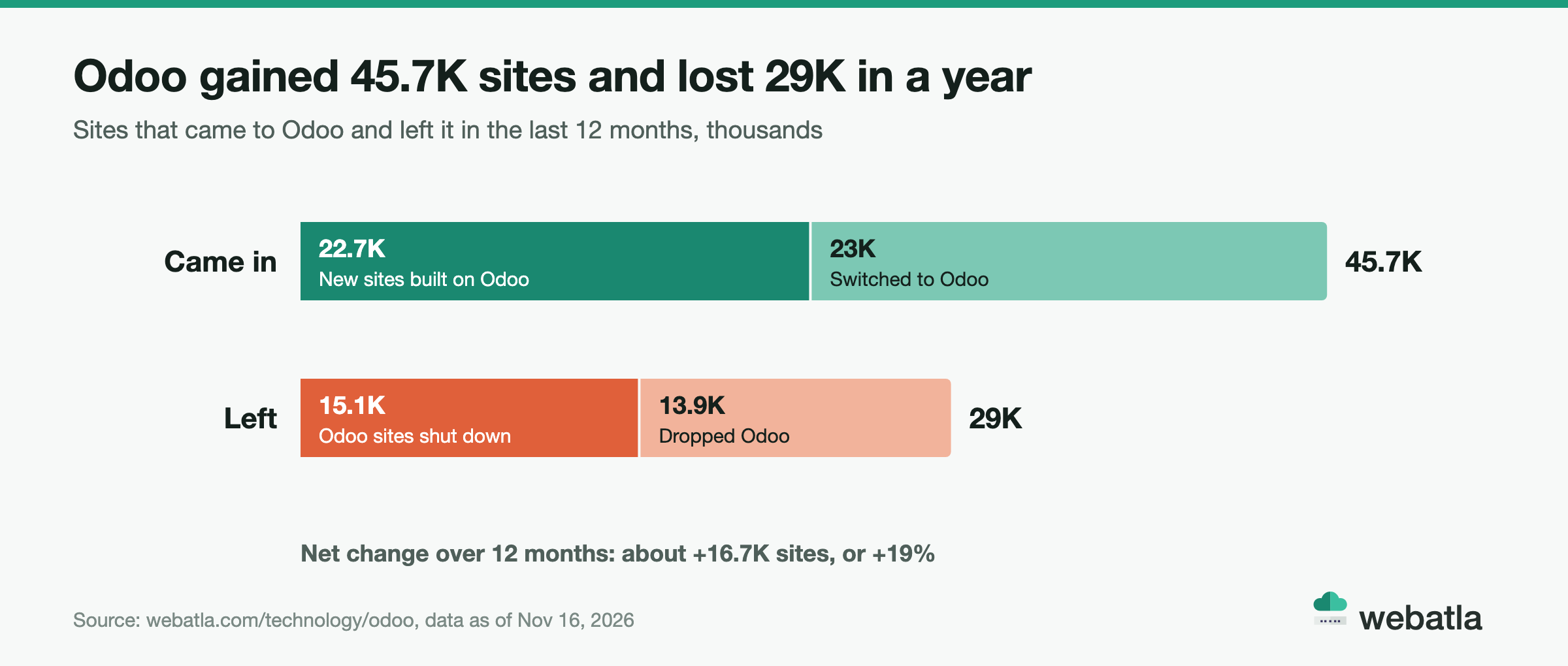
Over the last 12 months:
- 22.7K new sites started on Odoo. These are fresh websites that launched with it, about 62 a day.
- 23K existing sites switched to Odoo from another platform or a custom build.
- 15.1K Odoo sites shut down. The domain expired or the site went offline.
- 13.9K sites dropped Odoo and stayed online with something else.
That gives two separate results.
New sites: Odoo wins by 7.6K. 22.7K launches against 15.1K closures.
Switching: Odoo wins by 9.1K. For every 100 sites that moved to Odoo, about 60 moved away. Half of all arrivals are existing websites that changed platform, a sign that businesses move established sites onto the suite and do not only start new ones there.
Odoo growth slowed in 2026
The monthly data adds a detail the yearly totals hide. Odoo still gains sites every month, but the gains are getting smaller.
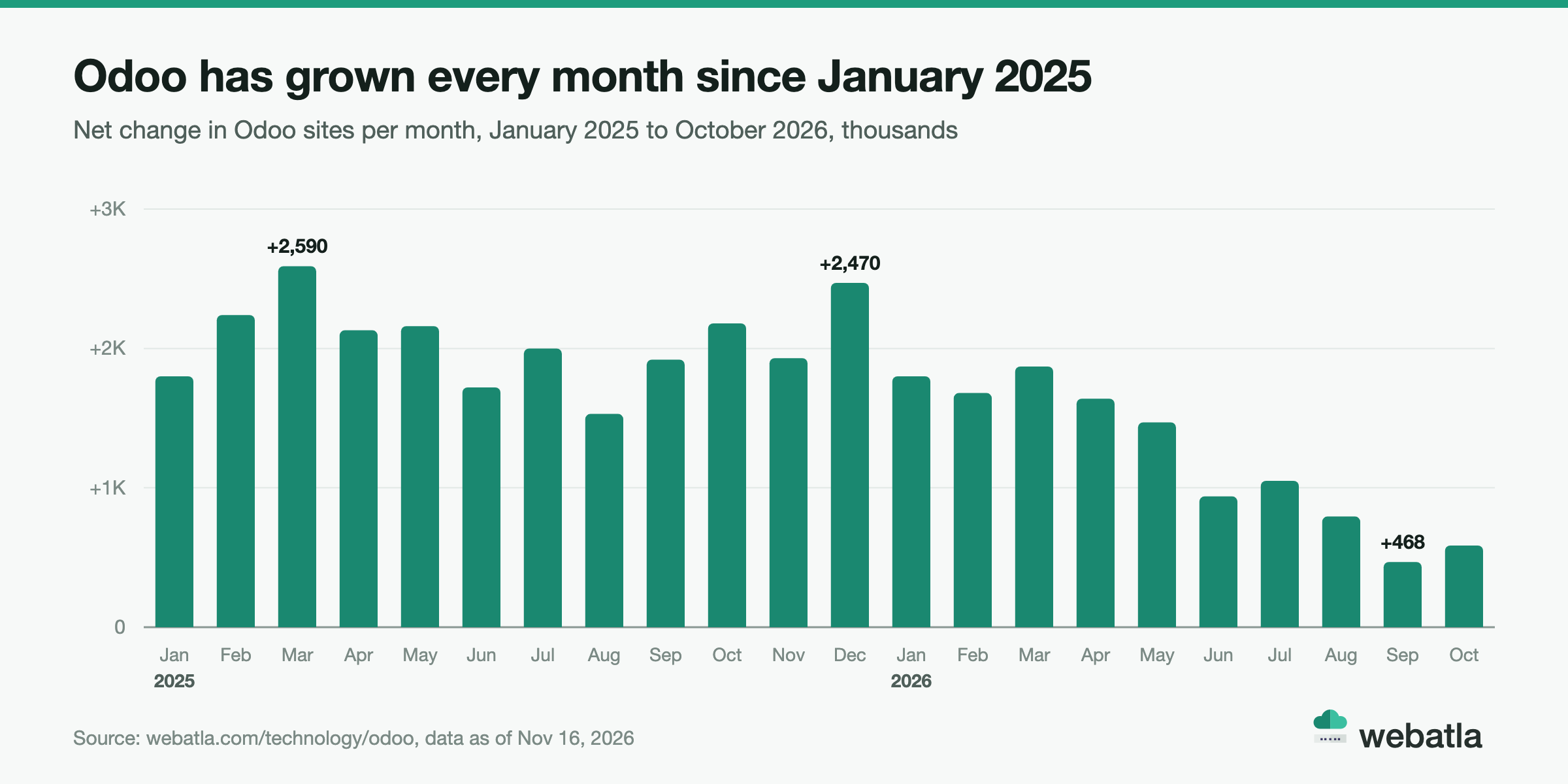
In 2025 every month added between 1,530 and 2,590 net sites, with no clear seasonal pattern. In 2026 the gains shrank. January to March added 5,350 sites in total. July to October added 2,900, about 720 a month. September 2026 was the weakest month in the period, at +468.
The reason shows up when you split the net change into its two parts.
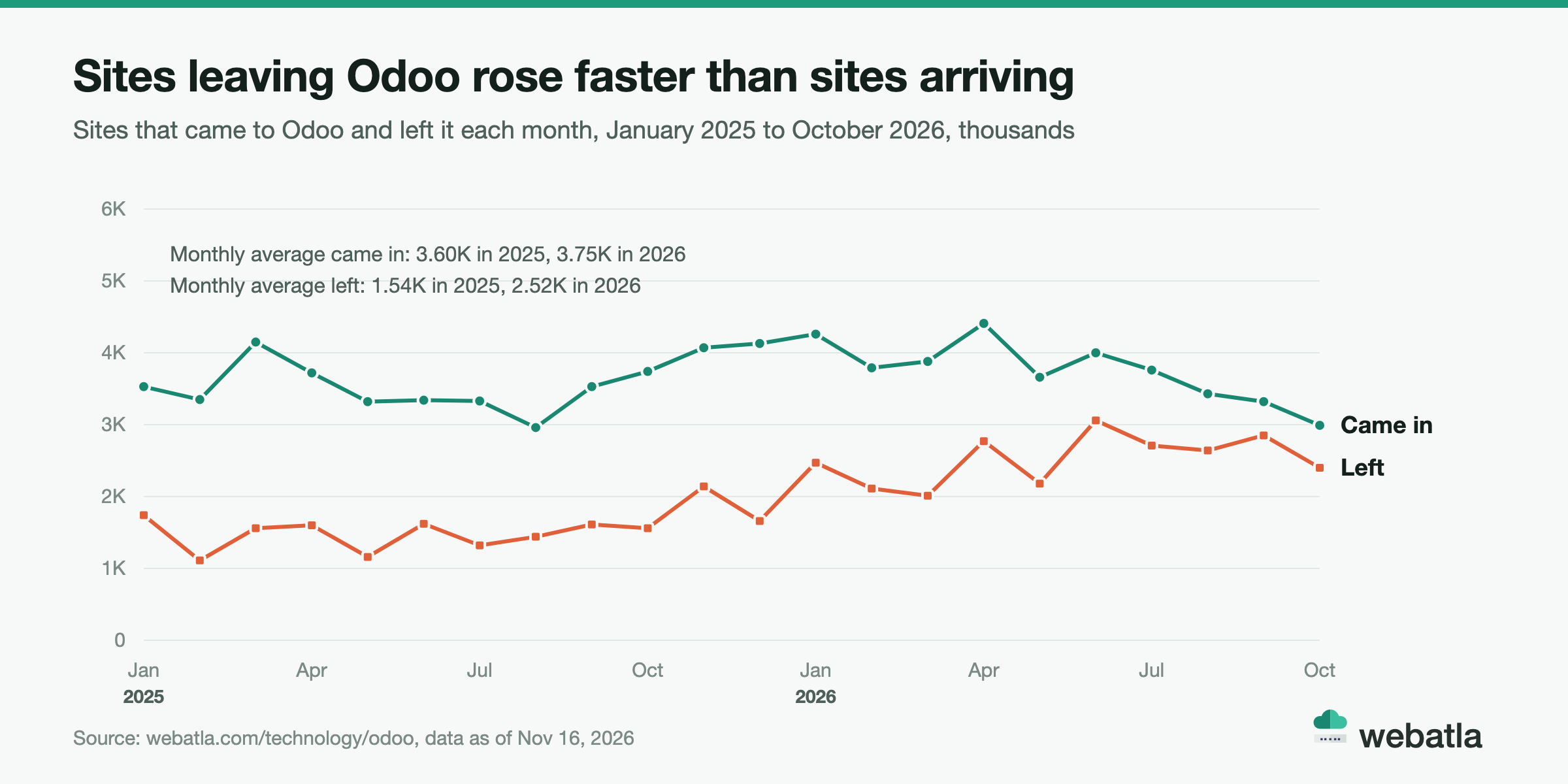
Arrivals held steady. Odoo gained 3.60K sites a month on average in 2025 and 3.75K in 2026, up 4%.
Departures rose by 63%. They went from 1.54K a month in 2025 to 2.52K in 2026. Both kinds of exit grew. Shut downs went from about 780 a month to 1,290. Sites that dropped Odoo went from about 770 a month to 1,230.
In 2025 Odoo kept 57 net sites for every 100 that came in. In the first ten months of 2026 it kept 33. Part of the rise in departures comes with size, since a bigger base has more sites that can close or move. But departures grew faster than the base did. Odoo is still growing fast, and the monthly files will show whether the 2026 slowdown continues.
Odoo vs Magento, PrestaShop and 1C-Bitrix: who is growing
The three-year view puts Odoo at the top of all the store and site platforms compared here.
The longer view since 2016 shows how far the middle of the market has moved:
| Platform | Sites, end of 2016 | Sites, October 2026 | Change since 2016 | Change, last 3 years |
|---|---|---|---|---|
| Odoo | 8.63K | 105K | +1,117% | +127% |
| Magento | 356K | 128K | -64% | +5.3% |
| 1C-Bitrix | 181K | 161K | -11% | -19% |
| PrestaShop | 216K | 60.5K | -72% | -52% |
| HubSpot CMS Hub | 17.8K | 50.9K | +186% | +20% |
| WooCommerce | 1.40M | 3.36M | +140% | +1.3% |
| Shopify | 497K | 3.27M | +558% | +61% |
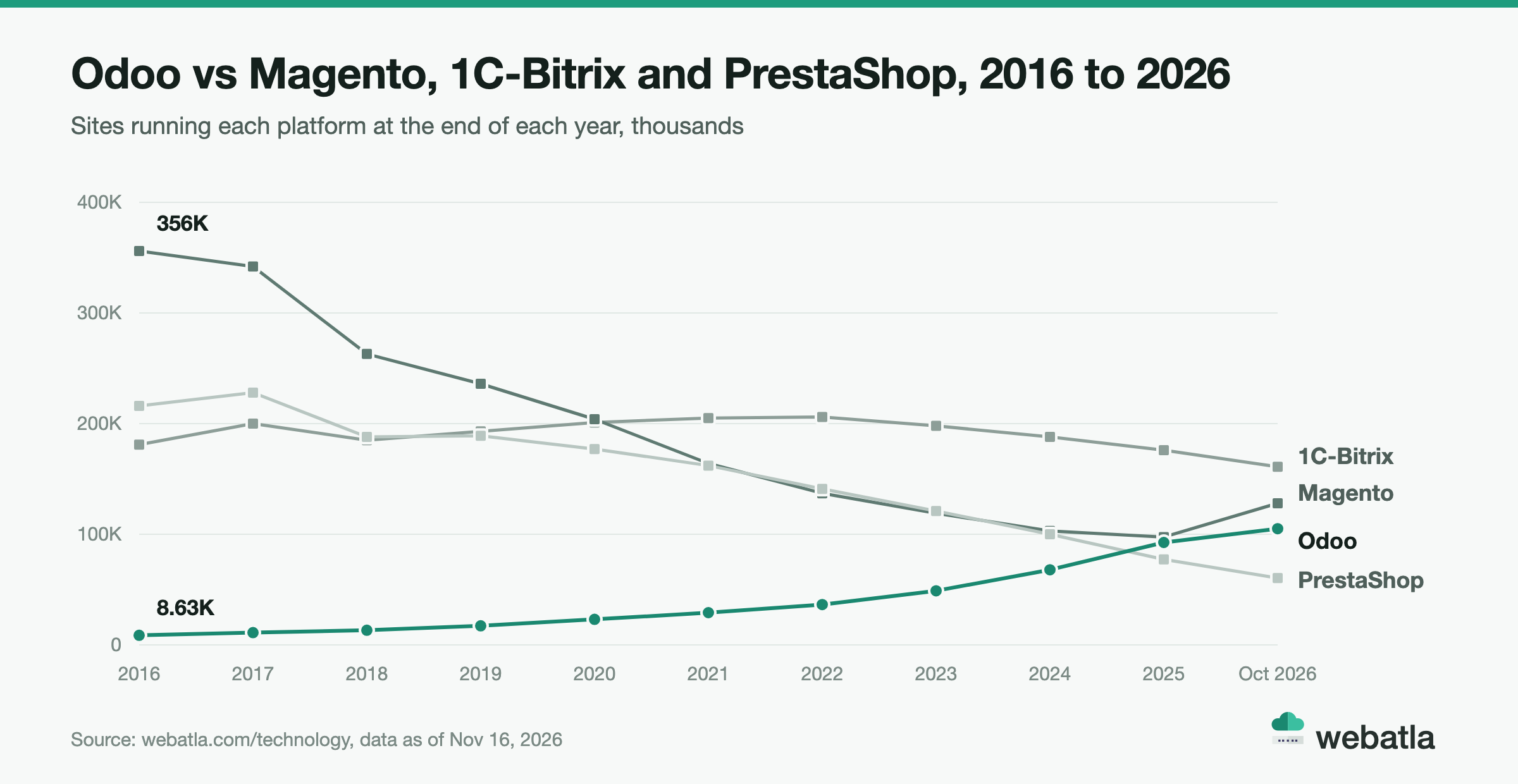
Odoo vs Magento. Magento lost sites every year from 2016 to 2025, falling from 356K at the end of 2016 to 97.5K at the end of 2025. Odoo closed in fast. In April 2026 the history model put Magento at 99.8K and Odoo at 99.5K, almost level. Then Magento turned around. Its monthly arrivals went from about 3.9K in January to April 2026 to about 9.4K from May to October, and it added a net 30.1K sites in the first ten months of the year. Magento changed by +34% over the last 12 months. That keeps it ahead for now.
Odoo vs PrestaShop and OpenCart. Odoo passed OpenCart in July 2025 and PrestaShop in August 2025. PrestaShop has lost 52% of its sites in three years. In the last 12 months 7.4K sites came to it and 27.3K left. OpenCart is down 8.7% over three years.
Odoo vs 1C-Bitrix. 1C-Bitrix is the largest platform in the middle group with 158,539 sites, but it changed by -19% in three years and lost a net 15.5K sites in the first ten months of 2026. If both keep their 2026 pace, Odoo would pass it in about two years.
Odoo vs HubSpot CMS Hub. HubSpot CMS Hub also ties the website to a business suite, in its case a marketing one. It has 50,858 sites and changed by +20% in three years, but -6.9% over the last 12 months. Odoo has about twice as many sites.
Odoo vs Shopify and WooCommerce. The two giants are about 31 times Odoo's size. Shopify grew 61% in three years and WooCommerce 1.3%, so Odoo is growing faster than both in percentage terms, from a much smaller base. More on the giants in our Shopify statistics and WordPress statistics.
Odoo in the Python web
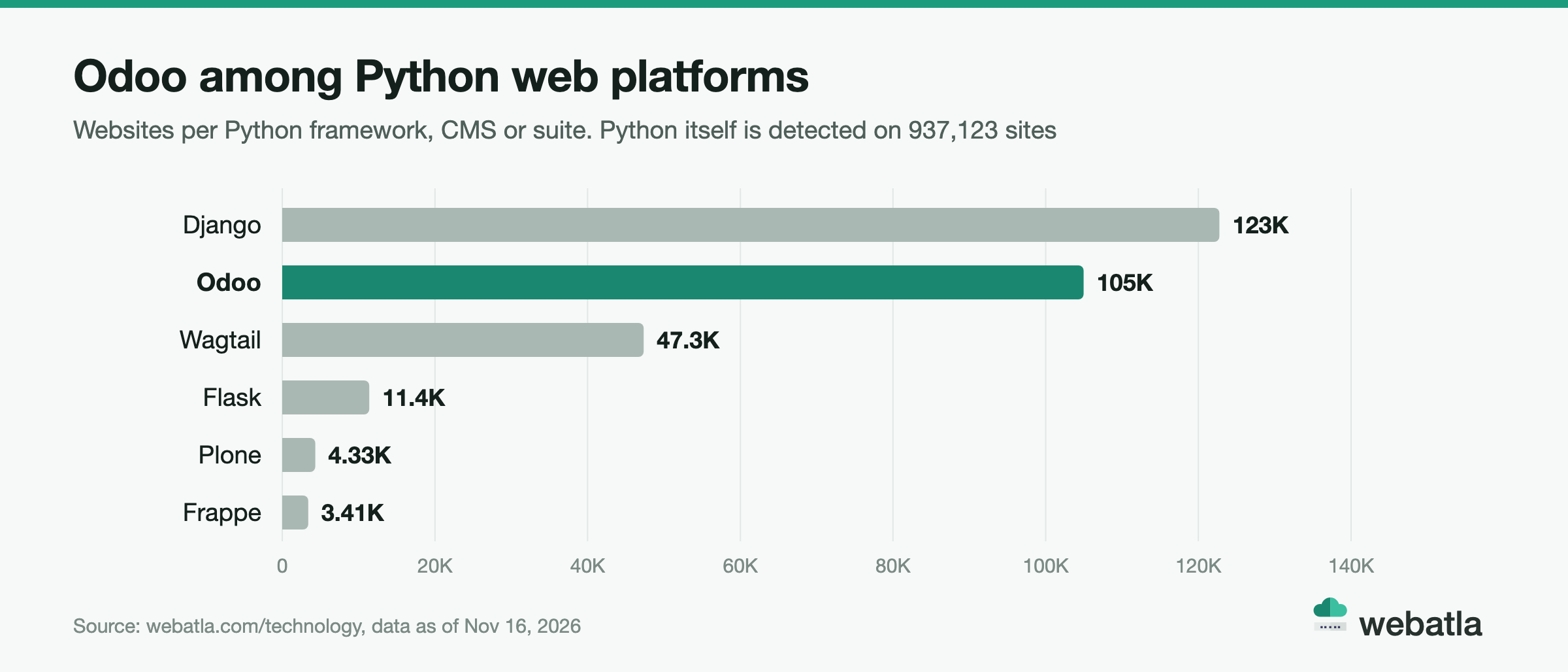
Odoo is written in Python, which makes it one of the largest Python platforms on the web. webatla detects Python on 937,123 websites, and Odoo's 104,967 sites are equal to 11.2% of that base.
| Technology | Type | Websites | Change, Oct 2023 to Oct 2026 |
|---|---|---|---|
| Django | Web framework | 122,755 | +28% |
| Odoo | CMS, CRM, Ecommerce | 104,967 | +127% |
| Wagtail | CMS | 47,332 | +104% |
| Flask | Web framework | 11,392 | n/a |
| Plone | CMS | 4,325 | n/a |
| Frappe | Web framework | 3,413 | n/a |
Only Django has more sites, and the gap is 17,788. Odoo is growing much faster, +127% in three years against +28% for Django. Python as a whole changed by -4.8% over the same period. So Odoo and Wagtail are growing inside a Python web that is slightly shrinking overall.
The stack around Odoo: PostgreSQL and Less
Two technologies in the webatla index follow Odoo almost site for site.
| Technology | Websites | United States | France | Germany | Belgium | Change, Oct 2023 to Oct 2026 |
|---|---|---|---|---|---|---|
| Odoo | 104,967 | 41,318 | 24,839 | 8,201 | 2,641 | +127% |
| PostgreSQL | 105,307 | 41,427 | 24,851 | 8,268 | 2,642 | +123% |
| Less | 109,788 | 42,174 | 24,992 | 8,524 | 2,648 | +93% |
PostgreSQL is detected on 105,307 websites, only 340 more than Odoo. Its country split, its three-year change and its 12-month flows (46K in, 29.6K out) are almost the same as Odoo's. A database is rarely visible from outside, and the PostgreSQL page itself describes the count as disclosures, not deployments. The near-perfect match is a strong sign that most websites where webatla sees PostgreSQL are Odoo sites.
Less, a stylesheet language, shows the same pattern. It runs on 109,788 sites, and its counts in the United States, France, Germany and Belgium are within 900 of Odoo's in each country. The Odoo front end is most likely the main reason Less appears on the web at this scale.
For a buyer this has a practical side. If you filter the technology file for PostgreSQL or Less, expect mostly Odoo sites. The Odoo list is the direct way to reach them.
Odoo usage by country
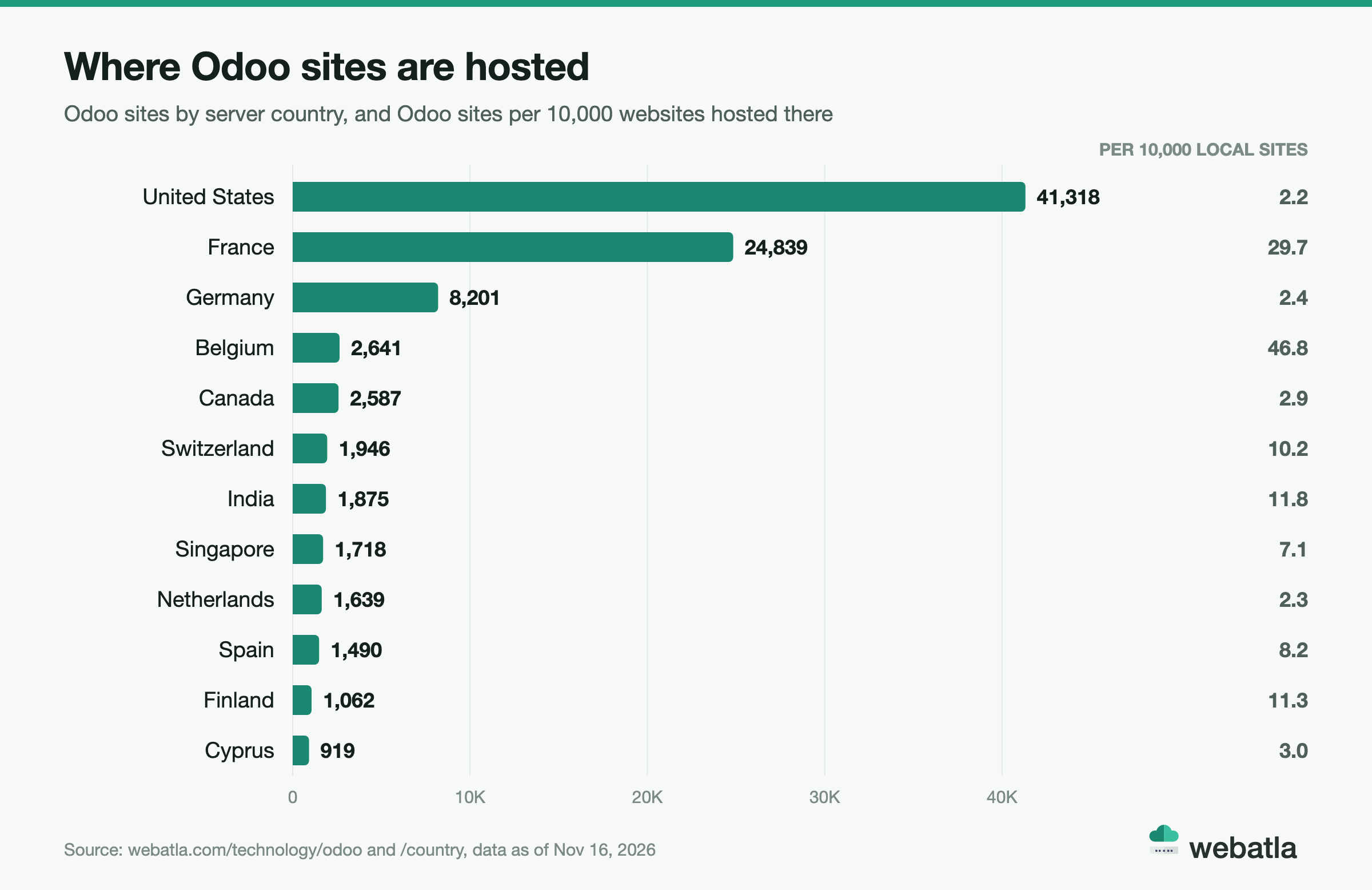
Country here means where the site's server is, by IP address, not where the owner lives. Shares are of Odoo sites with a known country.
| Hosting country | Odoo sites | Share of Odoo sites | Odoo sites per 10,000 local websites |
|---|---|---|---|
| United States | 41,318 | 40.6% | 2.2 |
| France | 24,839 | 24.4% | 29.7 |
| Germany | 8,201 | 8.1% | 2.4 |
| Belgium | 2,641 | 2.6% | 46.8 |
| Canada | 2,587 | 2.5% | 2.9 |
| Switzerland | 1,946 | 1.9% | 10.2 |
| India | 1,875 | 1.8% | 11.8 |
| Singapore | 1,718 | 1.7% | 7.1 |
| Netherlands | 1,639 | 1.6% | 2.3 |
| Spain | 1,490 | 1.5% | 8.2 |
| Finland | 1,062 | 1.0% | 11.3 |
| Cyprus | 919 | 0.9% | 3.0 |
Two countries host almost two thirds of the Odoo web. The United States has 40.6% and France 24.4%, 65% together. With Germany the three reach 73.1%.
France is far above its weight. It hosts 2.57% of all websites webatla tracks but 24.4% of Odoo sites. That is 29.7 Odoo sites per 10,000 hosted websites, 9.2 times the global rate of 3.2.
Belgium is the densest large Odoo market. 46.8 of every 10,000 websites hosted in Belgium run Odoo, 14.5 times the global rate. No other country that hosts more than 500,000 websites is higher. India, Finland and Switzerland sit just above 10 per 10,000. Small hosting markets can go higher: Saudi Arabia hosts only 16,590 websites, and 383 of them run Odoo, 2.3% of the local web.
Server country is a hosting signal first. France hosts 24,839 Odoo sites, but only 7,361 Odoo sites use a .fr domain. Germany hosts 8,201, while .de has 2,800. That is a sign that many Odoo sites from other countries run on servers in France and Germany. The United States has a low density (2.2 per 10,000) because US servers host 187 million websites, 57.4% of the web.
Odoo by domain extension
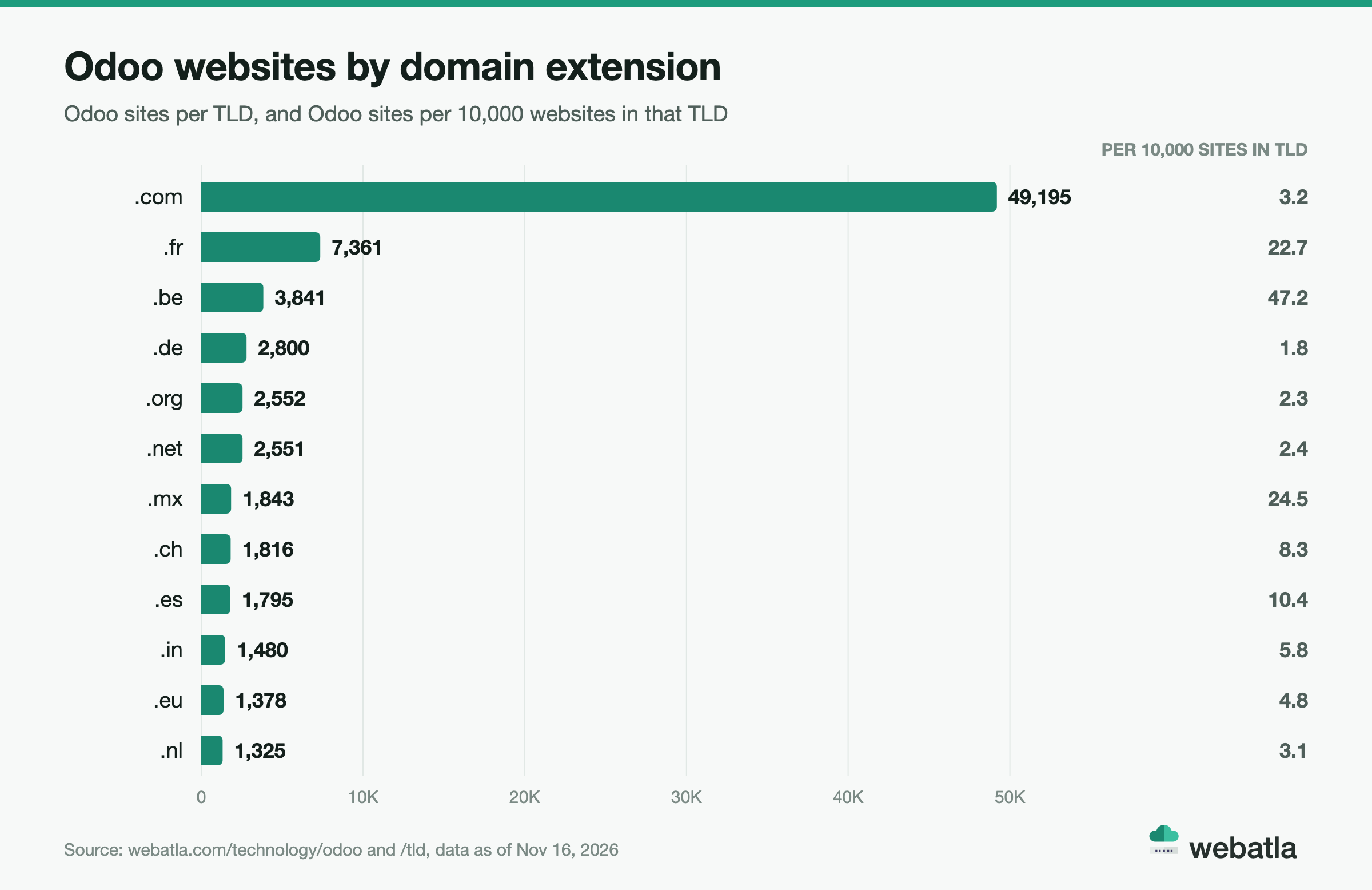
46.9% of Odoo sites use a .com domain, 49,195 sites. The country domains are a better hint of where Odoo customers are than the server country.
| TLD | Odoo sites | Share of Odoo sites | Odoo sites per 10,000 websites in the TLD |
|---|---|---|---|
| .com | 49,195 | 46.9% | 3.2 |
| .fr | 7,361 | 7.0% | 22.7 |
| .be | 3,841 | 3.7% | 47.2 |
| .de | 2,800 | 2.7% | 1.8 |
| .org | 2,552 | 2.4% | 2.3 |
| .net | 2,551 | 2.4% | 2.4 |
| .mx | 1,843 | 1.8% | 24.5 |
| .ch | 1,816 | 1.7% | 8.3 |
| .es | 1,795 | 1.7% | 10.4 |
| .in | 1,480 | 1.4% | 5.8 |
| .eu | 1,378 | 1.3% | 4.8 |
| .nl | 1,325 | 1.3% | 3.1 |
.be is the most Odoo-heavy extension. 47.2 of every 10,000 .be websites run Odoo, almost the same density as Belgian hosting. .fr follows with 22.7.
Latin America shows up in the domains, not in the servers. .mx has 24.5 Odoo sites per 10,000 websites, .ar 25.0 and .cl 20.1, as dense as .fr. Yet Mexico and Chile do not appear among the top 25 hosting countries for Odoo, so most of those sites are served from abroad. The Mexican, Spanish, Argentine and Chilean country domains together hold 5,517 Odoo sites, 5.3% of the total.
Germany is the opposite case. .de holds 2,800 Odoo sites, only 1.8 per 10,000 .de websites, the lowest density in the top 12.
What these Odoo statistics mean for business
A count of 104,967 is a headline. The value is in the segments inside it, and each group that sells into the Odoo market looks for a different one.
Implementation partners look for regions where Odoo is dense and growing. Odoo deployments are rarely self-installed, so behind many of these domains sits a partner who set up the platform and still maintains it. Belgium (46.8 per 10,000 hosted websites), France (29.7) and the Latin American country domains are the strongest pockets. Each year brings 22.7K new Odoo sites and 23K switchers, and many of them are fresh projects for a partner.
Vendors of competing business suites want companies that already run their operations on one system. The 104,967 Odoo domains are that list. 13.9K sites dropped Odoo in the last 12 months while staying online, and the next day's file shows what each of them runs instead.
App and module developers size a market before they build. A module for French businesses starts from 7,361 .fr sites and 24,839 sites hosted in France. One for Mexico starts from 1,843 .mx sites. The Python data adds a second filter, since Odoo is equal to 11.2% of the Python web.
Payment, shipping and marketing tools sell into Odoo stores. Each row lists the full stack, so you can see which Odoo sites already run a payment script, an analytics tag or a chat widget, and which do not.
Hosting and managed service providers follow where Odoo sites live. 73.1% sit on servers in the United States, France and Germany. 15.1K Odoo sites shut down in a year and 13.9K changed platform, and many of those moves most likely end or change a hosting account.
Analysts and investors follow the flows. Odoo grew 127% in three years, but in 2026 the monthly average of departures rose 63% while arrivals rose 4%. Only a full list compared month by month shows whether that turns into a plateau.
All of these questions are filters over the same list. You run them on your own copy of the data, as narrow as you need, and you can keep yesterday's file to see what changed.
How webatla counts Odoo sites
A few notes on method, so you can read the numbers correctly.
- The count. 104,967 is every website where Odoo was detected in today's file, whatever its HTTP status. The file is rebuilt every day, and each row is one domain.
- What a detection means. webatla sees the public side of an Odoo installation: a storefront, a customer portal, a booking page or a site built with the website module. An installation used only internally leaves no trace, so the real number of Odoo users is larger than any crawl can show. The community and enterprise editions cannot be told apart reliably from outside, and a hosted trial looks much like a live deployment on the day it is scanned.
- The base. "Websites" means the 325,803,430 domains that answer with a web server. The store group is the 12 largest platforms in the Ecommerce category, 7,336,224 sites, without the generic cart marker and the shop features of Squarespace and Wix. The 40 largest site platforms add up to 51,722,518 sites.
- History. Yearly and monthly figures come from webatla's monthly history of active sites, anchored to the webatla census of October 2026. The Odoo series starts in May 2016. Archive coverage is thinner before 2019 and some months between 2016 and March 2024 are estimates, so this article reads monthly detail only from 2025 and treats the years before 2019 as approximate. From November 2026 the counting model changed, so compare months with months and today's file with today's file.
- Peers. Three-year changes are as each technology page states them. YouCan, Kajabi, BigCommerce, Flask, Plone and Frappe have no history series yet, so they show n/a.
- Countries and TLDs. The country is where the server is, by IP address. Odoo sites per 10,000 websites use the country totals on the country list and the website counts per TLD on the TLD list.
Sites can hide or rewrite the signals used to detect Odoo, and a small share do. The numbers describe what is observable on the web, measured the same way every day.
Frequently asked questions about Odoo statistics
How many websites use Odoo?
104,967 websites use Odoo as of November 16, 2026, according to the webatla index. The count is refreshed every day on the Odoo technology page.
What percentage of websites use Odoo?
0.032% of all 325.8 million websites run Odoo, about one in 3,100. Among the 12 largest store platforms Odoo has a 1.43% share and ranks fifth.
What is the Odoo market share in 2026?
Odoo holds 1.43% of the 12 largest store platforms in November 2026. Without WooCommerce and Shopify, which hold 89.9% of that group, Odoo has 14.2% of the remaining ten. Among the 40 largest CMS and site platforms its share is 0.20%.
Is Odoo growing in 2026?
Yes. Odoo changed by +127% from October 2023 to October 2026 and by +19% in the last 12 months. It grew every month since January 2025, but the monthly gain fell from about 1,800 sites in January 2026 to 586 in October.
How many new Odoo websites are created every day?
About 62. In the last 12 months 22.7K new sites started on Odoo. Counting the 23K sites that switched to it, about 125 sites join Odoo every day.
How many websites switched to Odoo?
23K sites switched to Odoo in the last 12 months and 13.9K dropped it. For every 100 sites that moved to Odoo, about 60 moved away.
Is Odoo bigger than Magento?
No, not today. Magento runs on 128,122 websites and Odoo on 104,967. The two were almost level in April 2026, then Magento grew faster for the rest of the year. Odoo has already passed OpenCart and PrestaShop.
Which country has the most Odoo websites?
The United States, with 41,318 Odoo sites hosted there, 40.6% of the total. France is second with 24,839. Among countries that host more than 500,000 websites, Belgium has the highest density, 46.8 Odoo sites per 10,000 hosted websites.
Is Odoo the most popular Python platform?
Odoo is the second largest Python platform webatla detects, with 104,967 sites. Django is first with 122,755. Odoo is growing faster, +127% in three years against +28% for Django.
Get the full list of Odoo websites →
Every number in this article comes from one file. The webatla Odoo list holds all 104,967 websites running Odoo, one row per site, and it is rebuilt every day.
Each row gives you the domain, the full technology stack with versions, the IP address, hosting country, HTTP status, social profiles, PageRank and Harmonic rank, and the domain's creation and expiry dates. That means you can go far past the headline count:
- every Odoo site hosted in Belgium or France, or on a .mx domain,
- every Odoo store that already runs a payment script or analytics tag,
- every Odoo domain with its expiry date and the rest of its stack,
- every site that switched to Odoo since yesterday's file.
The Odoo list comes with the Technologies dataset for €159 a month: 313,947,451 websites, 3,000+ technologies, and ready files by technology, country and TLD. You can also download a free 20-row preview to see the format.