About webatla. webatla is a domain-intelligence platform. We crawl and fingerprint domains across the web and record which technology each site runs — the same class of tool as BuiltWith or Wappalyzer, with wider coverage. Every number on this page comes from the webatla index, last refreshed on 7 July 2026.
There are 2,850,244 websites made with Shopify live in the webatla index right now — 0.9% of every domain we track, and the second-largest dedicated commerce platform on the web behind only WooCommerce. This article breaks down where those stores sit, what their domains reveal, why the country data is not what it first looks like, and how to pull the full list of sites yourself.
What Shopify actually is
Shopify is a hosted (SaaS) e-commerce platform founded in 2006 and headquartered in Ottawa, Canada. Unlike a self-hosted stack, a merchant does not install Shopify on their own server — the store runs on Shopify's infrastructure, behind a custom domain or a myshopify.com address. That hosting model matters for the data below: it changes what "where a site lives" even means, and it is the reason sites powered by Shopify look different in the index from sites built on WordPress.
How many websites are made with Shopify?
The headline figure: 2,850,244 live stores run Shopify in the webatla index — 0.9% of all indexed domains. On its own that 0.9% sounds small, but the commerce category is narrow and concentrated. Here is how the count of websites made with Shopify compares with the other dedicated e-commerce platforms merchants choose.
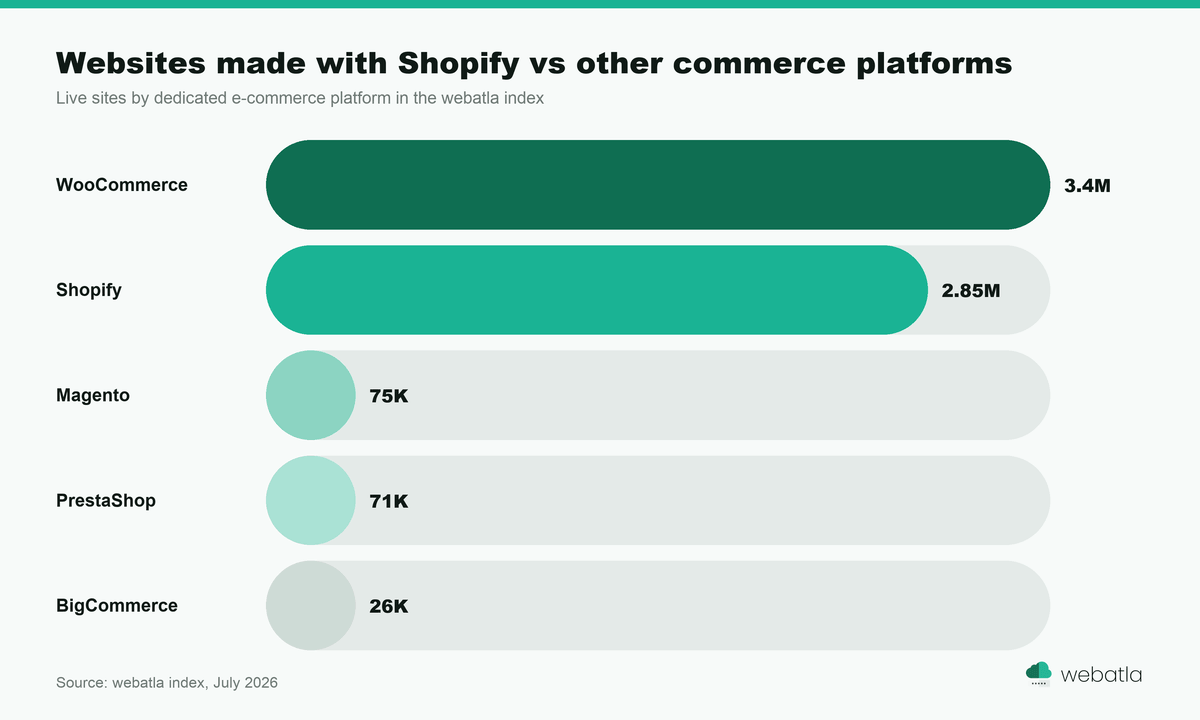
Live sites by dedicated e-commerce platform. Source: webatla index, July 2026.
- WooCommerce — 3,377,108 sites
- Shopify — 2,850,244 sites
- Magento — 75,035 sites
- PrestaShop — 70,633 sites
- BigCommerce — 26,333 sites
Two facts jump out. First, the commerce web is a duopoly: WooCommerce and Shopify together account for the overwhelming majority of detected stores, and everything else is a rounding error by comparison — Magento, PrestaShop and BigCommerce sit in the tens of thousands, not the millions. Second, Shopify is the largest hosted commerce platform, but it is not the largest commerce platform overall. WooCommerce — an open-source plugin that runs on WordPress — edges it by roughly 527,000 sites. Compare only SaaS platforms and Shopify wins outright; the one thing bigger is the self-hosted alternative on WordPress.
What the domain endings say
Domain endings are a useful fingerprint, and Shopify's are distinctive. Most sites that use Shopify sit on .com, but the next tier is unlike any general-purpose platform: purpose-built commerce TLDs.
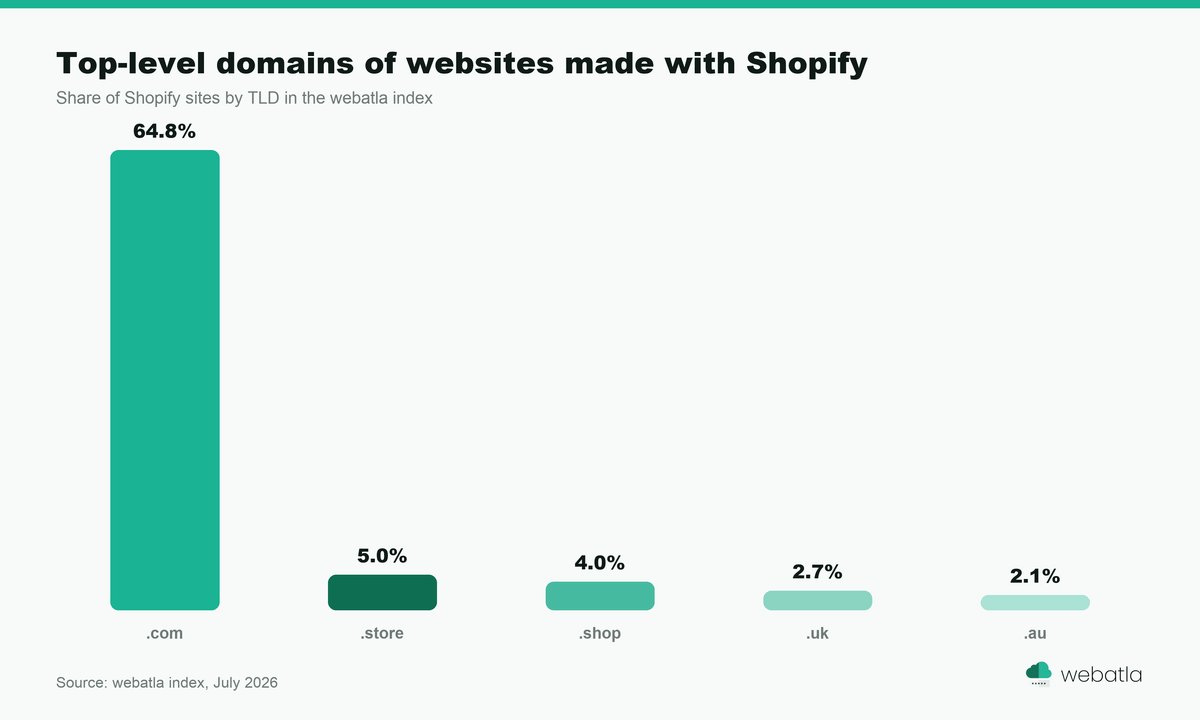
Top TLDs among Shopify sites. Source: webatla index, July 2026.
.com leads at 64.8% (1,846,439 domains), which is unremarkable. What stands out is second and third place: .store at 5.0% and .shop at 4.0%. Those are retail-only domain endings, and their prominence is a signal you rarely see outside commerce — a fresh crop of stores that registered a name that literally says "shop." After that come .uk (2.7%) and .au (2.1%), pointing to strong adoption in the UK and Australia. The .store/.shop cluster is the clearest domain-level tell that a population of sites is commercial rather than editorial.
Where webatla geolocates Shopify sites — read this carefully
Now the number that looks dramatic and needs context. In the index, 93.8% of Shopify sites geolocate to Canada, with the United States a distant second at 4.8%.
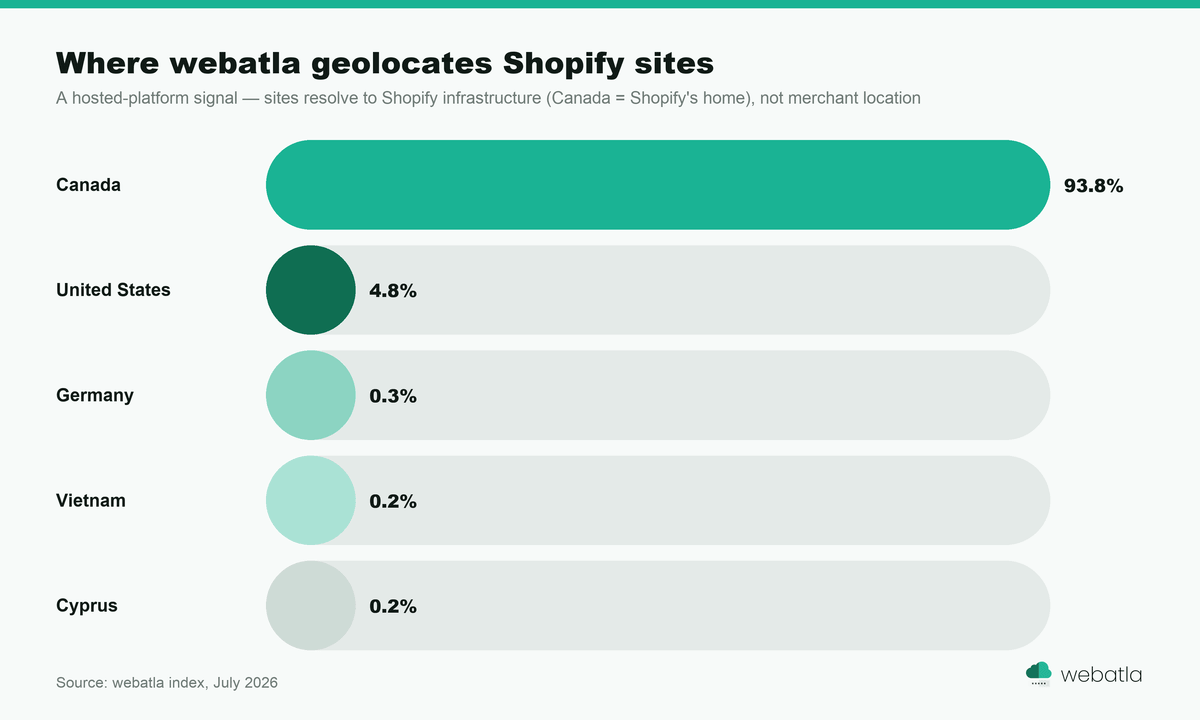
Geolocation of Shopify sites. Source: webatla index, July 2026.
This does not mean 94% of Shopify merchants are Canadian. It is a hosted-platform artifact. Because a store made on Shopify runs on Shopify's own infrastructure — and Shopify is a Canadian company — the domains resolve to that infrastructure, and webatla geolocates them accordingly. Canada here is Shopify's home, not the merchant's. This is the mirror image of self-hosted WordPress, whose sites scatter across thousands of independent hosts in dozens of countries because each owner picks their own server. The lesson is a data-literacy one: for any SaaS platform, the country breakdown tracks where the platform is served from, not where its customers are. Trust the TLD split — where merchants actually register their names — over the geolocation when you want to read demand.
Who builds on Shopify
The webatla index also detects the broader commerce landscape around Shopify — the platforms and features that show up when you fingerprint a shopping cart. Set against the wider field, Shopify sits mid-pack by raw count, because "commerce-capable" site builders inflate the top of the list.
Shopify's own detected examples are a fair cross-section of what the platform hosts: household retail names alongside niche shops. Among the live sites the index surfaces are myfonts.com, fleetfeet.com and fashionnova.com — a font marketplace, a running-shoe chain and a fashion brand — plus Shopify's own shopify.com. That spread, from single-product shops to nine-figure brands, is why the platform's store count is both large and commercially dense: nearly every one of these 2.85M domains exists to sell something.
See the full list of websites made with Shopify, filterable by country and TLD, on the Shopify technology page. →
Shopify in the wider commerce picture
Dedicated platforms are only part of the story. webatla also fingerprints commerce capability — the shopping-cart features bundled into general-purpose site builders — and by that broader measure the field reshuffles. Commerce on Squarespace shows up on roughly 7.6M sites and Wix eCommerce on about 1.4M, while WooCommerce sits near 3.5M in the same cut. The distinction matters: a site builder with a store feature switched on is not the same thing as a purpose-built shop. Shopify's 2,850,244 domains are overwhelmingly the latter — sites that exist to sell — which is why its store count carries more commercial weight per domain than a builder's optional commerce toggle. When someone asks which platform the real stores are on, the honest answer is Shopify and WooCommerce; the builders trail once you separate active shops from merely shop-capable pages.
Trends: the year-over-year number is an index recount
The webatla index records a -32.61% year-over-year change in detected live Shopify stores. As with any single snapshot delta, the honest reading requires looking sideways at the rest of the category.
Every commerce platform in the index fell in the same window: WooCommerce -61.70%, Magento -70.02%, PrestaShop -90.31% and BigCommerce -92.02%. When an entire category moves down together like that, the cause is a recalibration in how the index counts live installations between crawls — a recount — not millions of stores closing overnight. What is genuinely notable is the relative result: at -32.61%, Shopify shed the smallest share of any major commerce platform in this recount. Whatever the absolute counting method, Shopify held its detected footprint better than its rivals, which is consistent with a hosted platform that keeps stores live and reachable rather than leaving stale self-hosted installs to age out.
The durable signal is the standing: Shopify is the #2 commerce platform overall, the #1 hosted one, and more than 100× larger than the next dedicated hosted platform, BigCommerce.
How to see the list of websites using Shopify
You do not have to estimate any of this. The Shopify technology page on webatla is a live, filterable view of every store we detect. On it you can:
- Browse the running count of live websites made with Shopify (2,850,244 and updated as we re-crawl).
- Filter by top-level domain to isolate
.store,.shop,.comor country TLDs. - Compare Shopify side by side with WooCommerce, Magento and BigCommerce to see the full commerce field.
That is the fastest way to turn "Shopify is big" into an actual, workable list of websites that use Shopify.
Get the full list of websites made with Shopify
webatla maintains a live, filterable list of every Shopify store in the index — all 2,850,244 of them, sortable by TLD and country. It is the same data behind every chart above, kept current as we re-crawl the web.
→ Open the Shopify technology page to browse and filter the full list of sites powered by Shopify.
FAQ
How many websites are made with Shopify? webatla indexes 2,850,244 live websites made with Shopify as of July 2026 — 0.9% of every domain in the index, and the second-largest dedicated commerce platform behind WooCommerce.
Is Shopify or WooCommerce bigger? By raw site count, WooCommerce is slightly bigger (3,377,108 vs 2,850,244). Shopify is the largest hosted commerce platform; WooCommerce is a self-hosted WordPress plugin.
Why do 93.8% of Shopify sites show as Canadian? Because Shopify is a hosted platform based in Canada, its stores resolve to Shopify's own infrastructure. The country breakdown reflects where the platform is served from, not where merchants are based.
What domain endings do Shopify stores use?
.com leads at 64.8%, followed by the commerce-specific .store (5.0%) and .shop (4.0%), then .uk (2.7%) and .au (2.1%).
Where can I see a list of websites using Shopify? Open the Shopify technology page on webatla, where the full list of live Shopify stores is filterable by country and TLD.